A couple of years ago we built a small WordPress site for a friend who runs a removals firm in Brewood, Staffordshire. It's brewoodremovals.co.uk, a great local business with great local service. The site ranked. Then someone got over-excited about how easy it is to use AI to produce generic "moving tips" content at scale, and the site stopped ranking. Twelve months of Google Search Console data tells the story. 180 clicks against 111K impressions. Average position 40. Two hundred and twenty of 272 pages refused entry to the index. This post is what we learned, what every E-E-A-T explainer keeps glossing over, what "non-commodity content" actually means in practice, and the five-phase recovery playbook we're now running on the site. Names used with permission, because the only useful version of this lesson is the honest one.
Why people publish AI commodity content
If you've owned a website for more than five minutes, someone has told you that publishing more is the answer. More posts, more pages, more keywords, more impressions. The maths feels obvious. Twelve posts a year is a trickle. A hundred and twenty posts a year is a flood. AI has made the flood approximately free. Spin up a prompt, paste in a list of long-tail "moving" or "plumbing" or "Wolverhampton" keywords, and a content factory delivers the lot before lunch.
The trap is that it really does generate impressions. Google indexes a chunk of the new pages, surfaces them for low-volume queries, and the impressions counter ticks up. For a few months it looks like a strategy is working. The owner congratulates themselves. The agency that sold them the content pack writes a case study about "scaling content without scaling cost". And then the next core update lands and the whole thing folds, as the May 2026 update has just demonstrated again on Saturday 30 May.
Lily Ray, VP of SEO Strategy and Research at Amsive, summed it up in one tweet about Google's Opal launch:
"Optimized AI blog posts that will later get your site tanked by our own algorithms, got it"
Lily Ray, via Search Engine Land (November 2025)
That sentence stuck with me because it captures something most "AI for SEO" pitches won't say out loud. The optimisation isn't permanent. The volume isn't equity. Google's own guidance, repeated by Danny Sullivan and the wider Search team for years, is that AI assistance isn't the issue. Content "published primarily to generate SEO traffic, especially at scale" is the issue. The intent and the originality matter, not the keyboard or the model.
The brewoodremovals owner didn't set out to game anyone. He saw a tool that promised more visibility for less work, used it the way it was being marketed, and ended up in the trap that everyone running the same playbook ends up in. That's the part most blog posts on this topic don't admit. The trap catches well-intentioned people. The fix doesn't punish them, it teaches them what good content actually looks like.
What E-E-A-T actually means
E-E-A-T stands for Experience, Expertise, Authoritativeness, and Trustworthiness. The acronym shows up in Google's Search Quality Rater Guidelines, a document Google publishes for the human raters who train its ranking systems. The four qualities aren't a checkbox. They're a description of what good looks like, written in language a human can apply to a page they've never seen before. The trick is translating that into something a small business can actually do.
Experience: first-person, lived
Experience is the newest of the four. Google added it in December 2022 specifically because it had been losing the battle against confidently written content from people who had never done the thing they were describing. Experience asks: did the person writing this actually do it? A removals post that says "we collected a four-bedroom in Penkridge on Tuesday morning, the access was tight, the customer's grandfather clock was the heaviest item we lifted that month" beats one that says "moving house can be stressful, here are some tips". The first paragraph could only have been written by someone who was there. The second could have been written by anyone, anywhere, including a model that has never lifted a box.
Across our own writing at Press Forge we lean on this constantly. Our free WordPress security scanner walk-through is built on a tool we shipped at our sister company 365i and run on every client site, not a tool we read about. The post documents what it actually checks and how each check fails on a real WordPress install. The Experience signal isn't claimed, it's visible.
Expertise: domain knowledge, demonstrated
Expertise is what the writer knows about the topic. Crucially, it's demonstrated, not claimed. A first paragraph that says "as an expert with twenty years in the industry" is rhetoric. A paragraph that names the right tool, the right setting, the right edge case, and the price range is evidence. Expertise gets shown by getting specifics right. The cheap heuristic Google's raters use, and the one a reader uses, is identical: do the details land?
The brewoodremovals "moving-house-west-midlands" post is keyword-stuffed. It targets the phrase. It does not demonstrate expertise. There's no specific wage rate for two-man crews in the West Midlands, no comparison of access constraints between a Stafford terrace and a Wolverhampton semi, no commentary on which insurance covers which kind of damage. Expertise lives in those specifics. The post never reaches them.
Authoritativeness: recognised, cited
Authoritativeness is what the rest of the web says about you. It's links, citations, mentions, reviews, awards, organisational membership, accredited training, the whole external-validation layer. A small business can't conjure authority overnight, but it can stop fighting against it. A site with no author page, no organisation schema, no clear NAP (name, address, phone), no LocalBusiness type, and no outbound links to recognised sources is invisible to the systems that try to evaluate authority.
Trustworthiness: visible, verifiable, balanced
Trustworthiness is the most concrete of the four. Trust shows in the things you can put on a page. A visible author byline. A visible Published date. A visible Last reviewed date. An author bio that links to an editorial standards page. A balanced view that admits what the writer doesn't recommend. Real sources cited at the bottom. A real address in the footer. A real phone number that a real person picks up.
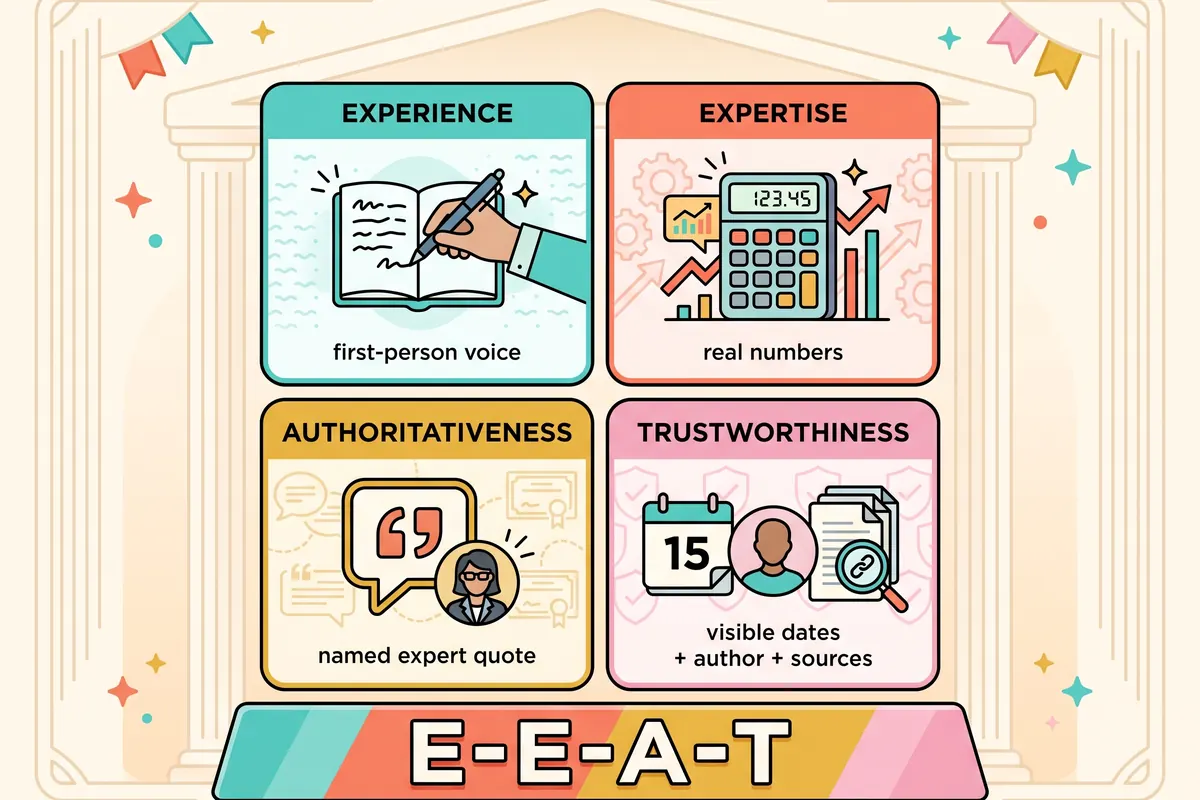
The brewoodremovals posts have none of those signals. No author. No dates. No bio. No editorial standards page. No source list. No balanced paragraphs admitting what the firm won't take on. The content might be readable, but the trust framing has been quietly stripped. That alone removes one of the four pillars before the reader has weighed a single sentence.
What "non-commodity content" actually means
"Non-commodity content" is a phrase Danny Sullivan from Google has been using for the better part of a year. It surfaced most loudly in a Search Central session in 2026 where he showed two columns of headline examples to make the point. The framework is distinct from E-E-A-T but related. Where E-E-A-T describes the qualities a page should have, non-commodity is a question about whether the page should exist at all.
Commodity content is content anyone could produce. "Top 10 Things to Consider When Buying Running Shoes". "7 Tips for First-Time Homebuyers". "2024 Kitchen Trends You Need to See". The common feature isn't AI. It's that any rival agency, any hobbyist blog, any model with access to the SERP could ship the same article without changing a single fact. The page adds nothing the index doesn't already have.
Non-commodity content is what's left when you take that test seriously. The post about why one customer's running shoes collapsed after 400 miles, with a wear-pattern photo. The post about why an interior designer refused to install marble for a family of five, with a stain-test on grape juice and turmeric. The post about why we waived the inspection on a property and saved fifteen thousand pounds. None of those could be written by anyone except the person who lived through them. That's the property Google now rewards.
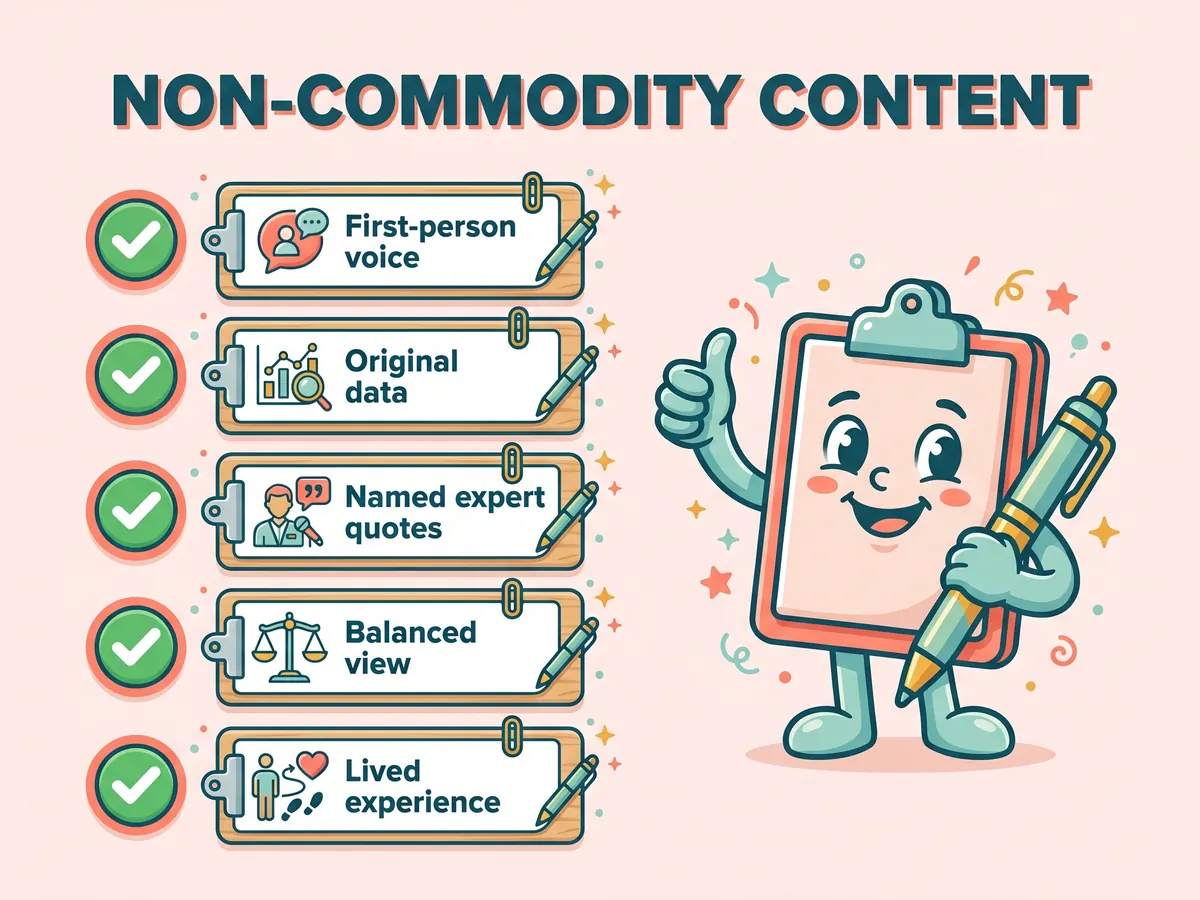
The numbers from the March 2026 core update bear it out. Pages with proprietary data and first-hand case studies gained roughly 15 to 25 percent visibility. Templated commodity content lost 30 to 50 percent. AI content farms with no first-person voice, no real cases, and no original data lost up to 80 percent. Those aren't projections, they're the post-update visibility tracking from Sistrix and Semrush across a wide sample of sites. The same shape repeated in May: when the May 2026 core update completed, our own non-commodity client pages took #1 organic positions while AI-built commodity pages stayed buried.
Non-commodity is also where E-E-A-T gets its teeth. Experience produces non-commodity content almost automatically, because lived knowledge is by definition something only the person who lived it can write. Expertise without lived experience tends to drift back toward commodity, because confident generalisations can be produced by anyone confident enough.
The clearest piece we've seen that explains and visibly demonstrates both ideas at once is this build guide on 365i.co.uk. We'd recommend reading it alongside this post. We're also, in a quieter way, trying to walk the same walk in our own coverage. Our deep dive into the WordPress 7 Abilities API security patterns isn't a recap of the docs, it's the specific permission and schema work we'd ask any agency to do before flipping the public flag, with code samples and an audit checklist. The same goes for the client palette audit where the brand orange failed WCAG at 2.59:1: a real brief, real measurements, and the exact script we ran. Those posts are non-commodity by construction.
The brewoodremovals.co.uk case study
This is the proof. Four pieces of evidence pulled directly from Google Search Console, with the owner's permission to share them publicly so the lesson lands. The framing is sympathetic throughout. A great local company, a well-meaning content decision, and a measurable outcome that anyone running the same playbook will eventually face.
Evidence 1: 220 of 272 pages refused entry to the index

The headline figure is the rejection rate. 272 URLs known to Google. 52 indexed. 220 not. That's an 81 percent rejection rate on a site that ranked fine before the AI content blitz. Worth pausing on, because it's the figure most agencies would never let a client see.
The "Why pages aren't indexed" table breaks the 220 down into six reasons. The two that matter are at the bottom of the table. Crawled, currently not indexed: 45 pages. Google fetched these pages, looked at them, and decided they weren't worth keeping. Discovered, currently not indexed: 160 pages. Google saw the URLs in the sitemap and the internal linking, and decided they weren't worth even crawling. Together that's 205 of the 220, around 93 percent of the rejection.
Neither reason is a technical fix. There's no robots.txt to repair, no canonical to swap, no server error to chase. Both are quality scores. Google has decided, page by page, that these URLs don't earn their place. The content itself has to change for those decisions to change.
Evidence 2: 180 clicks against 111K impressions
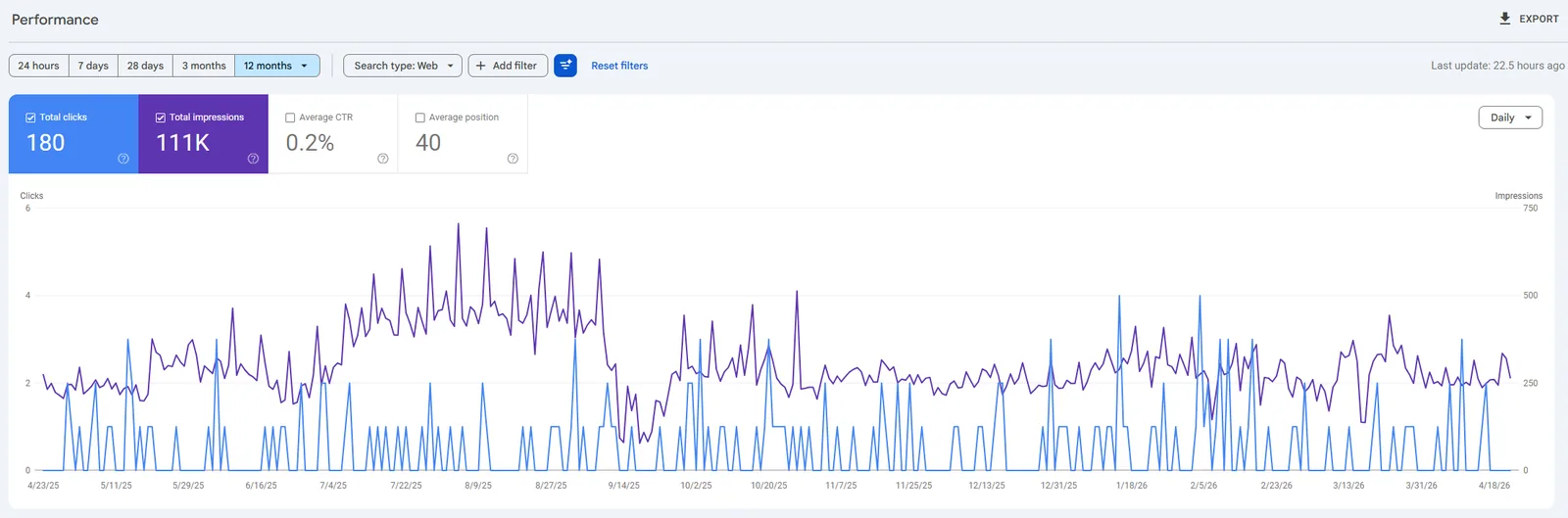
The 12-month performance view is the second tell. 111,000 impressions is not nothing. Google can clearly see the site, the keywords, and the intent the site is trying to match. 180 clicks against that volume is a 0.2 percent click-through rate. The industry baseline for any organic position above the fold is roughly 2 to 5 percent. At position 40, which is page four, click-through drops below 0.5 percent simply because almost nobody clicks past page two.
This is the part owners often misread. Impressions feel like progress. They aren't. The site is being shown to Google's indexing systems, not to users. The impressions counter is a measurement of how often the SERP rendered a result containing the site's URL. If that result is at position 40, no human is seeing it.
Evidence 3: the slugs are honest about their intent

The third piece of evidence is the URL list itself. moving-house-west-midlands. furry-friend. the-packing-debate. 10-great-tips-packing-fragiles. ultimate-guide-to-storage. professional-removals-company. The slugs don't lie. They're optimised for phrases, not for a person who walked into the office with a problem. None of them earned a click, because none of them earned a place in the index, because none of them were written for the kind of question Google now wants to surface answers to.
The owner didn't write these. A model did, briefed against a keyword list. That's the diagnosis the GSC report keeps pointing at. The pages aren't broken. They're empty.
Evidence 4: the structural layer is missing too
We checked the live page source on the site. There's no schema markup. No BlogPosting JSON-LD. No Author. No dateModified. No Organization. No LocalBusiness or MovingCompany. The HTML is bare. Google is being asked to crawl, evaluate, and rank dozens of pages with no machine-readable signal about who wrote them, when, where the business is, or what kind of business is publishing them.
Could schema have saved these posts? No. You can't structure your way out of bad content. But the absence of schema means even the legitimately useful pages on the site are competing with one hand tied. The fix has to address both layers. Not just so the bad pages stop dragging the site down, but so the good pages start carrying their weight properly.
And that's the recovery commitment we made with the owner. We're going to delete most of these posts, rebuild the few that have something real behind them, and put the structural layer back in place underneath. Recovery looks like a smaller, honest site, not a bigger, sloppier one. Update, June 2026: that rebuild is now live, and we wrote up exactly how it scored and the three build decisions behind it in How We Built a Removals Site ChatGPT Rates 99/100.
The same owner has a separate venture, Lockerfella, which we built from scratch in April 2026 with E-E-A-T and non-commodity content baked in from day one. Nineteen days after launch, that site was the #1 result on ChatGPT and Gemini for "brewood locksmith". Same owner, opposite outcome. We documented the build in the companion piece: How a 10-Day-Old Locksmith Site Hit #1 on ChatGPT and Gemini. Read it as the positive bookend to the recovery story above.
Since then the same playbook has run twice more, in trades with nothing else in common. In July 2026 we shipped a due-diligence brochure site for a brand-new distribution business, documented in the Cordley Solutions case study, and a 23-page chauffeur site that went from empty repository to live in 48 hours, documented in the Lincolnshire Chauffeur Services case study. Locksmith, removals, distribution, chauffeur: four builds, one pattern. Real experience on the page, claims the business can actually stand behind, and the structural layer underneath from day one.
The Fix: a 5-phase recovery playbook
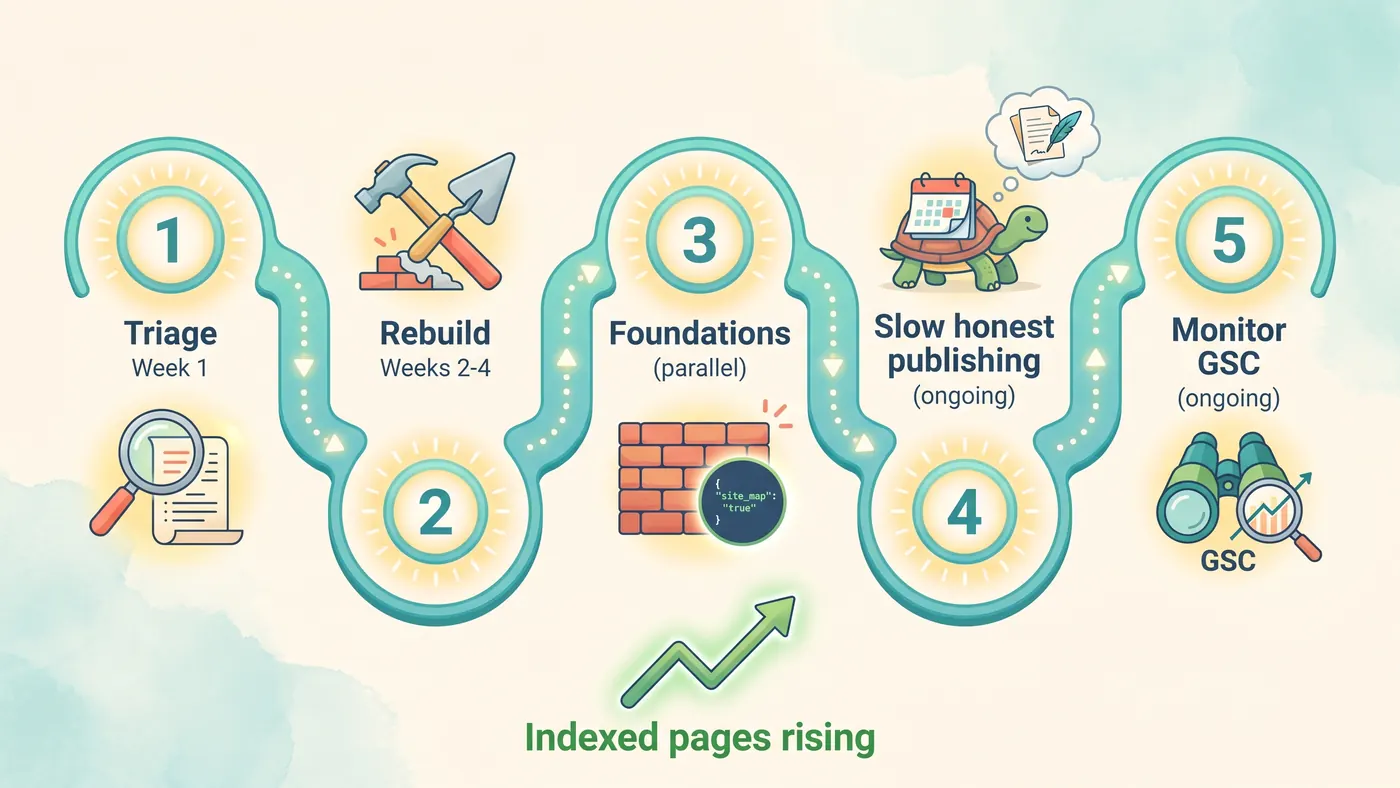
This is the part of the post that turns the case study into a playbook. The five phases are sequenced because the dependencies matter. Triage before rebuild, rebuild before publishing again, foundations laid in parallel, monitoring as the long-running discipline. Skipping a phase compresses the timeline by zero and adds risk to the work you've already done.
Phase 1: Triage (week 1)
Open Google Search Console. Pages report. "Why pages aren't indexed". Sort by "Discovered, currently not indexed" and "Crawled, currently not indexed". Read every URL. The temptation is to skim. Don't. The whole point of the exercise is to make a quality call on each post that the publishing process never did.
Sort each URL into one of three buckets. Delete: pure AI commodity, no salvageable angle, written for a phrase rather than a customer. Rewrite: real topic, bad execution, the underlying idea would help a customer if it were properly handled. Keep: actually useful, just needs better signals (schema, author, dates, sources). For brewoodremovals the bucket split is roughly 80/15/5.
For Delete, remove the post entirely and serve 410 Gone, not a 301 redirect. A 301 tells Google "this URL has moved permanently to that URL". 410 tells Google "this URL is intentionally gone, please remove it from the index". Neither has anything to redirect to, because the content was never legitimate value, and a 301 pointing to an unrelated page is itself a quality signal Google reads as manipulative.
Be brutal in this phase. The number of posts you keep is irrelevant. A smaller honest site with eight pages outranks a larger sloppy site with two hundred and seventy-two. Every post you keep has to earn the keep.
Phase 2: Rebuild what's worth keeping (weeks 2 to 4)
For each surviving post, six things have to be in place before it goes back live. A named author byline (a real human, not an agency placeholder). A visible Published date and a visible Last reviewed date. At least one real anecdote from the business owner, with permission and specifics (the road, the postcode, the obstacle, the time of day). At least one piece of original data the rest of the web doesn't have (typical price ranges, time taken, access constraints, what fits in a 3.5-tonne van). At least one balanced paragraph naming what the firm won't take on. Two to three internal links to closely related posts on the same site, plus a sources list of two to four external links to recognised authorities (the British Association of Removers, the relevant insurance body, official guidance pages). Six items, because that's the minimum stack of trust signals that move a post from "AI commodity" to "first-hand and credible".
Phase 3: Fix the foundations (parallel, week 2 onwards)
Run alongside Phase 2. Add BlogPosting schema to every post (with author, datePublished, dateModified, mainEntityOfPage, publisher, and a speakable selector for the title and excerpt). Add site-level Organization schema with the MovingCompany sub-type, full NAP, opening hours, and areas served. Add a real Author page with Person and ProfilePage schema. Publish a public /editorial-standards/ page so Google's quality raters and human readers can both find your editorial process. Validate every block with Schema.org Validator and Google's Rich Results Test before deploy.
For a copy-pastable worked example of every block, including the exact JSON-LD a small business should ship, see the "Expose it to machines" section of the 365i build guide. There's no value in us reproducing it inline. The 365i piece walks through it cleanly and we recommend reading it alongside this section. WordPress 7 Block Bindings are also worth a look at this point: the same fields that feed your visible content can feed your JSON-LD, which keeps the structured data and the page in sync without a second pass.
Phase 4: Publish slow and honest (ongoing)
Stop AI-generated commodity content. The new schedule is one to two posts a month, maximum. Every post is drawn from real client interactions (with permission), real seasonal patterns the firm sees, or real local events. Every post gets the full E-E-A-T treatment from day one. No "we'll add the schema later". No "we'll get a real photo when we have time". The cost of a sloppy publish is now the entire content brief. Publish well or don't publish.
The volume drop is the part owners struggle with. Going from sixty AI-generated posts a year to twelve real ones feels like a regression. It isn't. Twelve real posts will earn more clicks across a year than 250 commodity posts. That's the maths Google has been quietly imposing since the Helpful Content system landed.
Phase 5: Watch the recovery in GSC (ongoing)
The "Discovered, currently not indexed" count will start dropping over the four to twelve weeks after the 410s propagate. The Indexed count will start rising as the rewritten posts get re-crawled. Click-through rate on the surviving pages will rise above 0.2 percent because fewer-but-better pages match queries they can actually serve. Average position will improve slowly. Patience is part of the plan.
Worth being honest about how slow "slowly" can be. John Mueller, Google Search Advocate, has been clear that recovery doesn't require waiting for the next core update:
"it's not something that requires a site to kind of wait for the next update to have a chance to be seen differently"
John Mueller, Google Webmaster Hangout (4 September 2020)
That's the encouraging part. The work itself produces signals. You're not stuck waiting for Google to flip a switch. The cautious part, which Mueller has also said in different words across multiple hangouts, is that the systems re-evaluate at their own pace. A real improvement to a site can take months to be fully reflected, even though the trajectory starts to bend almost immediately. Watching the GSC indexability and click numbers each week, not each day, is the right way to track it.
Why we recommend the 365i build guide
Before writing this post we ran the SERP for the obvious queries: "how to show E-E-A-T", "non-commodity content", "Google E-E-A-T checklist", and so on. Most of the top 20 results are themselves commodity. Generic explainers that recite the four letters of E-E-A-T, lift Google's own examples without comment, and finish with a CTA. We had two pieces in mind that walk the walk, and we wanted to flag both.
The first is the build guide on 365i.co.uk. We've linked to it twice already. The third reference is intentional, because it's the piece we'd point a small business owner at as the worked example. It contains the exact structural layer we rebuilt for brewoodremovals.co.uk, now live and documented in its own case study: schema blocks, author signals, editorial standards page, the lot. Reading it alongside this post gives you the "what we did" and the "how a finished version looks" in one pass.
The second is this case study showing a real 97 mobile PageSpeed score on managed WordPress hosting. Performance is part of the same quality story that Google has been rewarding. A page that loads slowly, has no schema, and reads like commodity content fails three quality bars at once. A page that hits 97 mobile, ships full schema, and reads like the person who runs the business actually wrote it, hits all three. The 97-mobile piece is the parallel example: an agency demonstrating the outcome with real numbers, not just describing the goal. If you want a working benchmark for what a properly-shipped small site looks like in 2026, those two posts together are the cleanest reference we know.
Commissioning a New WordPress Site? Make the Content Decision First.
If you're commissioning a new WordPress site, the time to think about content quality is before the build, not after. The wrong agency will quietly suggest "we can run a content plan that publishes 5 to 10 AI-assisted posts a month". That's the road to brewoodremovals. We'll help you build a small, honest, expert-led site where every page earns its place.
WordPress Design ServicesPublished: 26 April 2026 · Last reviewed: 22 July 2026 · Written by: Mark McNeece, Founder & Lead Developer, Press Forge
Editorially reviewed by: Mark McNeece on 22 July 2026 · Our editorial standards
Frequently Asked Questions
What does E-E-A-T stand for?
E-E-A-T stands for Experience, Expertise, Authoritativeness, and Trustworthiness. It's the framework Google's Search Quality Raters use to evaluate content, and the qualities Google's automated systems learn to approximate. Experience is the newest of the four, added in December 2022 to make first-hand, lived knowledge an explicit ranking signal.
Is E-E-A-T a ranking factor or just a guideline?
Google has said E-E-A-T isn't a single score that gets added to a page. It's an emergent property of dozens of granular system signals: who wrote a page, when it was last reviewed, how it's linked to from elsewhere, whether the publishing entity is recognised, and so on. Treat it as a set of qualities that real ranking systems try to measure, not a setting you toggle on.
Can I use AI to help write blog posts at all?
Yes. AI as a research assistant, a first-draft tool, or a copy editor is fine. AI as the publisher, generating dozens of posts that nobody at the business has lived through, is the trap. Google's own guidance is that the problem isn't AI assistance, it's content produced primarily to manipulate search rankings at scale. If you wouldn't put your name to it, don't publish it.
How is E-E-A-T different from Google's Helpful Content system?
E-E-A-T describes the qualities Google wants to see in a page or a site. The Helpful Content system is the machinery that tries to identify and demote pages that don't have those qualities. They're two ends of the same conversation: E-E-A-T is the target, Helpful Content is the enforcement.
How do I show "Experience" if I'm not a household-name expert?
Experience isn't fame. It's first-hand knowledge of the thing you're writing about. A removals firm owner writing about how a Brewood-to-Wolverhampton job actually went has more experience signal than a Forbes contributor who has never moved a wardrobe. Use real numbers from your week. Name the streets, the postcodes, the obstacles, the prices. The stuff you'd say in the pub is the stuff a search engine can't fake.
Will adding schema markup fix my ranking on its own?
No. Schema is the machine-readable label on the box. If the box is empty, a label doesn't help. Schema's job is to make sure good content is read correctly, not to dress up bad content. The right approach is to fix the content first and add schema as the structural finishing layer.
Should I delete low-quality blog posts, or rewrite them?
Delete the ones that have nothing real behind them. Rewrite the ones where the topic is sound but the execution was AI commodity. Return 410 Gone for deletions rather than 301 redirects, because these URLs never had value to redirect. A smaller honest site outranks a larger sloppy one.
How does Google decide whether to even index a page?
Crawl budget and quality budget are separate. Google can crawl a page and decide it's not worth keeping (Crawled, currently not indexed). Google can also see a URL exists and decide it's not worth the bandwidth to even fetch (Discovered, currently not indexed). Both are quality judgements, not technical errors. The fix is the content, not the robots file.
Does adding an author bio improve E-E-A-T on its own?
Only if the bio is real and the writing reads like the named person actually wrote it. A faceless bio attached to AI commodity content is worse than no bio, because it's an unkept promise. Match the byline to the voice. If three people write under one name and the styles are different, you have a credibility problem the bio can't paper over.
Sources
- Google Search Quality Rater Guidelines (PDF) - Google
- Creating helpful, reliable, people-first content - Google Search Central
- Google's new AI tool touts creating optimized content in a scalable way - Search Engine Land (Lily Ray quote, November 2025)
- Google says you can recover from core updates without a new core update - Search Engine Land (John Mueller quote, September 2020)
- Google On Not Publishing Commodity Content - Search Engine Roundtable
- Google March 2026 core update rollout is now complete - Search Engine Land
- Google's Broad Core Updates: Relevancy, Intent and Site Quality - GSQi (Glenn Gabe)
- How to show E-E-A-T and non-commodity content: a build guide - 365i
- How we hit 97 mobile PageSpeed on managed WordPress hosting - 365i