On 8 April 2026 we shipped a new custom-built site for a one-man locksmith in Brewood, South Staffordshire. Nineteen days later, on 27 April, ChatGPT placed it first under "Local Brewood locksmiths" for the query "brewood locksmith". Gemini placed it first under "Top Local Recommendations". Google had it at position 3 organic. The site had no backlinks, no reviews, no domain authority, and no verified Google Business Profile at the test point. Mobile PageSpeed scored 100, 100, 100, 100. This post is exactly what we built and why it produced a top result on AI search in nineteen days when most "rank on ChatGPT" guides quote three to six months. The site is lockerfella.co.uk. For where it stands two months on, across Google, the map pack, Google's AI Overview and ChatGPT, see our follow-up on whether ChatGPT recommends local businesses.
The result, on day 19
Before we get into how, here is what happened. AI Visibility published a public case study walking through the queries, the AI engines tested, and the screenshots from each. You can read the full study at AI Visibility - Lockerfella case study, where the ChatGPT and Gemini result panels are reproduced in full. The headline numbers are there in black and white.
From day 19:
- ChatGPT: position 1 under "Local Brewood locksmiths" (only entry in that section)
- Gemini: position 1 under "Top Local Recommendations"
- Google: position 3 organic; map pack still held by call-centre lead aggregators because the GBP was not yet verified
- Claude AI: did not surface Lockerfella at the test point. Worth saying, because honest case studies include what didn't work too. AI engines vary, and they re-evaluate continuously. We expect this to change as the site ages and the open web indexes catch up.
Mobile PageSpeed the next morning, captured directly from PageSpeed Insights:

Update - day 21: ChatGPT, Gemini, and Google all show Lockerfella first
On 29 April 2026, two days after this post went live and twenty-one days after Lockerfella's launch, we re-ran the same recommendation queries on a fresh Temporary Chat in ChatGPT, a fresh Temporary Chat in Gemini, and a fresh Brewood-located Google search. All three returned Lockerfella as the first recommendation. The day-19 result has held on the AI engines, and Google has now caught up.

ChatGPT, on a Temporary Chat with no memory and no prior context, leads with Lockerfella under "Best locksmiths in Brewood (right now)". It cites the hyper-local positioning, a real-world review noting a roughly ten-minute response, non-destructive entry and no upsell, and pulls a Trustpilot citation. The day-19 result is unchanged.

Gemini, also on a Temporary Chat, returns Lockerfella as item 1 ("Local Specialist"). The summary specifically cites the ST19 postcode area, non-destructive entry, uPVC and anti-snap lock upgrades, Sean operating as an independent man-with-a-van, and lifts the phone number directly. Day-19 result also held.

Google moved Lockerfella to position 1 organic. The map pack still belongs to lead aggregators with longer review histories. The first organic result below the map pack is now Lockerfella's homepage, with a rich snippet pulling the 24/7 line, the phone number, and the catchment.
We did not touch the site between day 19 and day 21. The same content, schema, and AI Discovery Files that ChatGPT and Gemini ranked first on day 19 are what Google ranked first on day 21, and what ChatGPT and Gemini are still ranking first today. The classic-SEO playbook quotes three to six months for a result like this in a competitive local niche. Lockerfella did it in twenty-one days, with the same evidence working for AI engines and for Google.
The brief: a brand-new locksmith site, in a dirty niche
The owner of Lockerfella is Sean Hamilton. We have known Sean a couple of years; we built the original WordPress site for his removals firm at brewoodremovals.co.uk. That older site is the case study we wrote up earlier this week on E-E-A-T and non-commodity content, where bulk AI-generated "moving tips" content quietly tanked the site over twelve months. Two hundred and twenty of 272 pages now refused entry to Google's index. That is the negative companion piece to this one. Same owner, opposite outcome. We will not retread the lesson here; the linked post does it properly. We have since rebuilt that removals site from scratch as well, and ChatGPT scored the finished build 99/100 against the national brands: the full teardown is in How We Built a Removals Site ChatGPT Rates 99/100.
For Lockerfella, Sean came to us with a fresh venture and a clean slate. One man, one phone, one van, one canonical domain. No call centre, no franchise, no doorway-page strategy. Locksmithing is also one of the dirtier niches in local search; lead aggregators have spent the better part of a decade flooding the SERP with low-credibility content designed to capture the click and forward the call. Beating them on classic SEO would have meant outspending them on links and reviews for a year. We weren't going to do that. We were going to put up an honest site that was easier for both humans and AI engines to understand than anything the aggregators had bothered with.
The build philosophy from day one: make every page worth visiting on its own merits, structure the entire site so a machine can read it cleanly, ship the AI Discovery Files at launch (not "later"), and refuse the SEO shortcuts the client had been pitched (more on those further down). Then publish slowly, honestly, in Sean's voice.

Experience, on the page
E-E-A-T's first E is Experience. Google added it in December 2022 specifically because confidently-written content from people who had never done the thing was outperforming first-hand accounts. The fix, as far as a small business site is concerned, is to make first-hand experience visible on every page that matters.
For Lockerfella that meant: Sean's photo, Sean's actual van, Sean's first-person voice, and a "Recent Jobs" section listing real call-outs by date and street. The About Sean page opens with "I'm Sean Hamilton, and I run Lockerfella. One man, one van, one phone number." There is a photograph of him next to the van and a pull quote that begins "Thirty years of getting my hands dirty". Nobody has to take that on faith; the rest of the site corroborates it. Sean talked through the original brief and his reaction to the finished site in a post-launch interview on our sister design site: Sean Hamilton: The Full Lockerfella Interview. His line about wanting a website that "feels local, not fake local, actually local" is the brief in one sentence.

The Recent Jobs section is the part that does the heaviest experience-signal lifting. It is a curated list of real call-outs with the date, the part of town, the lock involved, and what was done. "Late February, a Friday afternoon. Caroline Whitehouse, Stafford Road, Penn (Wolverhampton). Caroline rang after she'd come home to find scratch marks around the cylinder of her 1990s uPVC front door. Nasty, but someone had clearly tried to grip and snap the original Avocet euro." Nobody who had not done the work could write that paragraph. AI summarisers can spot the difference. So can quality raters. So can buyers.

Expertise, made visible
Expertise is what the writer knows about the topic. On Lockerfella we showed it by getting the specifics right. Service pages name the right brand of euro cylinder. The emergency lockouts page talks about anti-snap upgrades to BS 3621 standard for insurance compliance. Where the page might have said "we fix locks" it instead says: "Most of the emergency lockouts I get called to are uPVC front doors where the euro cylinder has snapped, dropped a pin, or the gearbox has finally given up. The 1990s and 2000s estates around Wolverhampton, Cannock and the wider West Midlands are full of doors with cylinders that were never anti-snap rated, and most are still being replaced one by one, usually after they fail."
That paragraph is unimprovable by an AI working off the SERP. It names the housing stock by decade, the specific lock failure modes, the specific geography, and the specific upgrade path. Expertise is demonstrated by detail, not declared by adjective.

That headline paragraph is not the only non-commodity block on the page. Every service page on Lockerfella also ships a "Recent Call-Out" sidebar with a fully written-up real job, plus a "From The Locksmith" first-person tip. The Emergency Lockouts page carries this one, lifted from Sean's diary:
Recent call-out. A Sunday evening last month, around half past nine. Mr and Mrs Ahmed, Hatherton Road, Cannock.
Locked out of a 1990s uPVC front door. Original key had snapped clean off in the cylinder, half wedged in the keyway. Mrs Ahmed had been about to take their toddler to bed when it happened.
Out-of-hours rate £170 quoted on the phone before I left Brewood. On their doorstep in around 25 minutes. Non-destructive entry by picking, then the snapped half extracted with a proper extractor in under a minute. Replaced the tired old cylinder with an Avocet ABS TS007 3-star while on site. Two new keys cut on the van. Inside in 30 minutes, no damage to the door or frame.
Read that and count the signals an AI engine, a quality rater, or a worried customer can lift directly: a named family, a real road in a real town, an exact time of day, a precise failure mode, the price quoted before leaving Brewood, the response time, the technique, the brand of part fitted, the time on site, and the outcome. None of it could be produced by a content scraper. The Lock Repairs page has a different call-out, the Commercial Locksmith page another, the uPVC and Residential pages each their own. Five service pages, five real call-outs, plus a "From The Locksmith" first-person tip on each. None duplicated. All sourced from Sean's diary. The pattern is what makes a small site uncopyable: a rival cannot replicate Sean's diary without doing Sean's work.
Same on the homepage's "What I Do" grid. Five services, plain English on each, and a real example of when Sean would or would not turn up. The site does not pretend to be five locksmiths. It is one man, listing what he can credibly do.

Authoritativeness, the slow lane
Authoritativeness is the one nobody can fake on day 19. It is what the rest of the web says about you, and the rest of the web has not had time to say much yet. So we did the things that compound: a clear NAP, an Organization schema, a LocalBusiness schema with verified hours and a service area, links between every page that respect the site's actual hierarchy, outbound links to recognised sources where they help.
What we deliberately did not do was the SEO shortcut Sean had been pitched elsewhere: registering several keyword-stuffed domains and 301-redirecting them to lockerfella.co.uk. Exact-match-domain redirect chains are something Google has been able to spot and devalue for years; the original EMD update landed in 2012 and successive core updates have hardened the detection. At best they do nothing. At worst they send a manipulation signal that drags the entire site. We said no on the spot. The energy and budget went into one canonical domain, slow honest publishing, and the structural identity layer below.
The slow lane on authority is not glamorous, but it is the one that survives core updates, as the May 2026 update has now demonstrated for the second month running. Mark McNeece, who founded AI Visibility and drafted the AI Discovery Files specification, put the underlying point cleanly:
"AI Visibility is not about being found. It is about being understood."
Mark McNeece, Founder of AI Visibility, in the AI Visibility Explained Q&A
That sentence reframes the whole project. A site that AI engines understand will tend to be cited correctly the moment a real query needs a real answer. A site that is hard to understand needs years of authority signals to compensate. We chose to make Lockerfella very easy to understand on day one.
Trustworthiness, baked in
Trustworthiness is the most concrete pillar. It is the things you can put on the page. A visible owner. A real address area. A real phone number. A clear pricing posture. A useful FAQ that answers what worried customers actually ask. A boundary on what is and is not within reach.
Lockerfella shows the owner's name and face. It states "no call-out fee, you only pay for the work" up front. The Common Questions section answers the questions a worried customer actually has, in first person, with timing estimates that are honest rather than aspirational. "For local jobs around south Staffordshire I aim to be on your doorstep within 15 to 30 minutes. For Wolverhampton, Cannock, Stafford, Walsall, Birmingham and the wider West Midlands, allow 30 to 45 minutes. If I'm on another job I'll tell you straight away so you can decide what to do. Either way, you get a clear time, not a vague promise."
That accordion is the human-facing layer. The same Q&A is also emitted as full FAQPage schema in the page markup, with each Question entity carrying a url property that points to the matching anchor on the page. AI engines can lift the answer text cleanly, and Google can deep-link a searcher directly to the question they asked rather than dropping them at the top of the page. Most local sites ship visible FAQs or FAQPage schema. Lockerfella ships both, agreeing with each other line for line.

Non-commodity content, page by page
Danny Sullivan from Google has spent the better part of a year talking about commodity vs non-commodity content. The framework is brutal in its simplicity: commodity content is anything any rival could publish without changing a fact. Non-commodity content is the post that could only have come from one source. Google's March 2026 core update has measurably rewarded the second and demoted the first.
The biggest temptation in local SEO is to publish "doorway" area pages: short pages that exist to capture a town name, with no specific content beyond a templated paragraph and a phone number. We refused that pattern. Lockerfella's area pages each name real streets, real housing stock, real quirks. The Brewood locksmith page talks about the sandstone cottages on High Green and Stafford Street. The Cannock locksmith page knows the town centre estates. The Rugeley locksmith popup on the area selector explains what neighbouring villages are also covered and why.


This is the structural opposite of a doorway page. A doorway page exists to catch a keyword. An area page on Lockerfella exists because Sean drives there. The same pattern carries through the Wolverhampton locksmith, Stafford locksmith, Walsall locksmith and Birmingham locksmith pages: real journey times from Brewood, real estate types, real failure modes, no template.
Seven more area pages worth a click. The Cannock locksmith page tells the Hednesford break-in story on Pye Green Road, where Jenny Marsh's back door had been forced overnight, the original 5-lever mortice destroyed and the keep splintered. Sean made good the damage, fitted a fresh BS 3621 mortice plus a high-security rim nightlatch, and was on site within 35 minutes of the Sunday-morning call. The Codsall locksmith page walks through a five-step composite-door diagnosis checklist that came straight off the bench. The Penkridge locksmith page covers a grade-II-listed cottage near the church where Sean fitted a Yale 5-lever BS 3621 mortice into an existing 100-year-old pocket without touching the joinery. The Wombourne locksmith page debunks the dropped-door myth on Common Road, where Dave and Tracy Williams had been quoted £950 for a new door before Sean fixed the existing one for well under a fifth of that. The Lichfield locksmith page deals with a Bird Street Georgian front in the cathedral conservation area, where the BS 3621 mortice has to fit the existing pocket without joinery. The Sutton Coldfield locksmith page handles a 1930s Four Oaks semi with the same constraint. The Dudley locksmith page tells the Russell's Hall window-strip story where a £400-per-window replacement quote was beaten by a £170 visit covering both. Generic content briefs cannot produce that copy.
Area pages done properly, section by section
The pattern across Lockerfella's area pages (eighteen when this post went up, nineteen now) is the bit most local-SEO operators miss. The information architecture repeats: every page has a hero block with the postcode and journey time, an opening paragraph that names the town, a "From the Doorstep" diagnostic section, a "Recent Jobs" panel with three call-outs, an FAQ, and a CTA. Standardised scaffolding, page after page.
The copy does not repeat. Each page's "From the Doorstep" addresses a different real diagnostic: Codsall walks through composite-door alignment, hinge wear, and snap-attack vulnerability; Penkridge handles the conservation question of upgrading a 100-year-old timber front to BS 3621 without ruining it; Wombourne debunks the "my door has dropped, I need a new one" myth that costs people £900-plus unnecessarily; Dudley diagnoses the wedged-window espagnolette failure mode. Every page's "Recent Jobs" panel lists three jobs that actually happened in that town, with the road, the customer's name, the date, the part fitted, the time on site, and the price.
The newest page, added after this post first ran, is the clearest example of the whole idea. The Telford locksmith page diagnoses a town rather than a door. Telford's New Town estates went up in the late seventies, the original timber doors were swapped for uPVC around the same twenty-year mark, and the multi-point gearboxes behind them now fail in clusters because they were all fitted at once. Sean describes the progression the way a customer actually experiences it: first the door needs a firmer lift on the handle, then it needs a shove, then one morning the handle goes all the way up and nothing throws. No keyword tool produces that paragraph. Only someone who has driven the A5 into TF postcodes for years can write it.

That is not a CMS doing place-name find-and-replace on a single template. That is a working tradesman writing copy from his diary, eighteen times, with the help of an opinionated content brief that refused to ship a page until it carried its own evidence.

Why it matters for Google and for AI engines: every URL is independently citable. A summariser asked about "Codsall locksmiths" lifts the composite-door checklist. One asked about "Penkridge locksmiths" lifts the listed-cottage answer. Neither has anything generic to fall back on. The pages do not compete with each other, because they are not selling the same content with a different town slug. They are selling eighteen different pieces of evidence that the same person did the work in eighteen real places.
The 9 AI Discovery Files at lockerfella.co.uk
Lockerfella ships the full nine-file specification at the root of the domain, matching the AI Visibility Discovery Files specification. Every file is live, every file is open to view, and every file is cross-referenced from the others so an AI engine that finds one is told where the other eight are.
Open them yourself:
- llms.txt: AI-readable business identity and context, in Markdown, following the llmstxt.org convention
- llms.html: human-readable HTML version with embedded Schema.org structured data
- ai.txt: AI usage permissions, restrictions, and attribution requirements
- ai.json: machine-parseable AI interaction guidance with JSON Schema validation
- identity.json: structured canonical identity record aligned with Schema.org Organization
- brand.txt: brand naming conventions and representation guidance
- faq-ai.txt: structured Q&A optimised for AI consumption
- developer-ai.txt: technical context for AI systems assisting developers
- robots-ai.txt: AI crawler-specific access directives using robots.txt syntax
There is also a tenth file, llm.txt, which 301-redirects to llms.txt because the singular alias still gets used by some bots. Total cost in build time: a couple of hours. Total weekly maintenance: zero. The discovery layer is built once and stays correct because it pulls from the same canonical identity data the rest of the site uses.

Speed: mobile PageSpeed 100, 100, 100, 100
Speed is not optional in 2026. Mobile is where the queries land, and AI engines that summarise web content prefer pages they can fetch and parse quickly. Lockerfella was built to hit green across the board on mobile from launch.
How: every CSS bundle is minified and split per page; below-the-fold styles are deferred via the print-onload trick; the LCP image is preloaded with fetchpriority="high"; fonts are self-hosted with font-display: swap; JavaScript is bundled as IIFEs and loaded with defer; static assets are cached for one year on the CDN; the home server has gzip on every text response and an aggressive expiry policy on images. The result on the day we tested: First Contentful Paint 1.1 seconds. Largest Contentful Paint 1.7 seconds. Total Blocking Time 0 milliseconds. Cumulative Layout Shift 0. Speed Index 1.8 seconds.
Those four green 100s on the screenshot earlier are not a fluke. They are the outcome of an opinionated build, the same one we ship for every Press Forge client. Our sister hosting team at 365i wrote up the launch-day teardown for this exact site: Lockerfella: 100 PageSpeed at launch - 365i. Our sister design team at 365i Web Design wrote up the brief-to-build side of the same project: He Asked for a Proper Locksmith Website. He Got Mission Control. For the methodology applied to a much larger site, see how we hit 97 mobile PageSpeed on managed WordPress hosting.

Schema on every page (and how we proved it)
Detailed schema on every page is not a "nice to have". It is critical infrastructure for three audiences at once. Google parses it to power rich results and feed its understanding of the page. AI engines lift it directly into citations and answers. And it acts as a trust signal in its own right: schema commits the site to specific, checkable claims (hours, address, services, prices, FAQs) in a form a third-party validator can audit, and a page where the visible content disagrees with the structured data is one Google and AI engines learn to rank lower, cite less, and trust less. The reverse also holds. A page whose schema agrees with what the human reader can see is a page both audiences will reward.
Every page on Lockerfella ships JSON-LD schema. The homepage and area pages carry LocalBusiness with verified opening hours, geo coordinates, and an areaServed list. Service pages carry Service. Every page carries BreadcrumbList. The Common Questions section carries FAQPage. The site as a whole declares Organization at the root, and identity.json mirrors the Organization properties so the discovery layer agrees with the on-page schema. The schema is detailed, validated, and consistent with the visible page on every URL.
The validation is not "we hope so". We ran every page through both Google's Rich Results Test and Schema.org Validator before launch and after.

That screenshot is from the /areas/ page. The pattern repeats on the homepage, every service page, every area page, and the about page. Six valid items per page on average. Zero errors. Zero warnings. Schema.org Validator returns the same clean result. None of this guarantees rich results in the SERP (eligibility is not entitlement), but it does guarantee that an AI engine reading the page can answer questions about Lockerfella correctly. That, more than anything, is what AI search rewards.
The 19-day result, by AI engine
To stop and check what all of the above had actually produced, on 27 April we typed "brewood locksmith" into four AI engines, in incognito sessions, with no prior history. The full screenshot panel sits on the AI Visibility case study; here is the summary.
ChatGPT (search-enabled): rendered a "Local Brewood locksmiths" panel with one entry. Lockerfella. The site was named, the service summarised in plain language, and the link was included. Position 1 of 1. We did not pay for placement. We did not feed it instructions. The engine chose Lockerfella because the AI Discovery Files were clear, the LocalBusiness schema was clean, and the on-page content matched the query intent.
Gemini (Google's): "Top Local Recommendations" panel, three entries. Lockerfella was first. The other two were national directory pages. Same pattern: schema cleanliness and identity files outranked larger but less credible competitors.
Google organic: position 3. The map pack at the top of the SERP was held by call-centre lead aggregators, because the GBP for Lockerfella was not yet verified at the test point. We expect to overtake them within weeks once verification completes. The classic-organic position is already strong relative to what a 19-day-old domain "should" achieve.
Claude AI: did not surface Lockerfella for the same query at the test point. Worth being upfront about. Different engines weight different signals, and Claude's web layer was less aggressive about lifting fresh local results at that moment. We expect this to change as the open web indexes catch up.
What Sean said
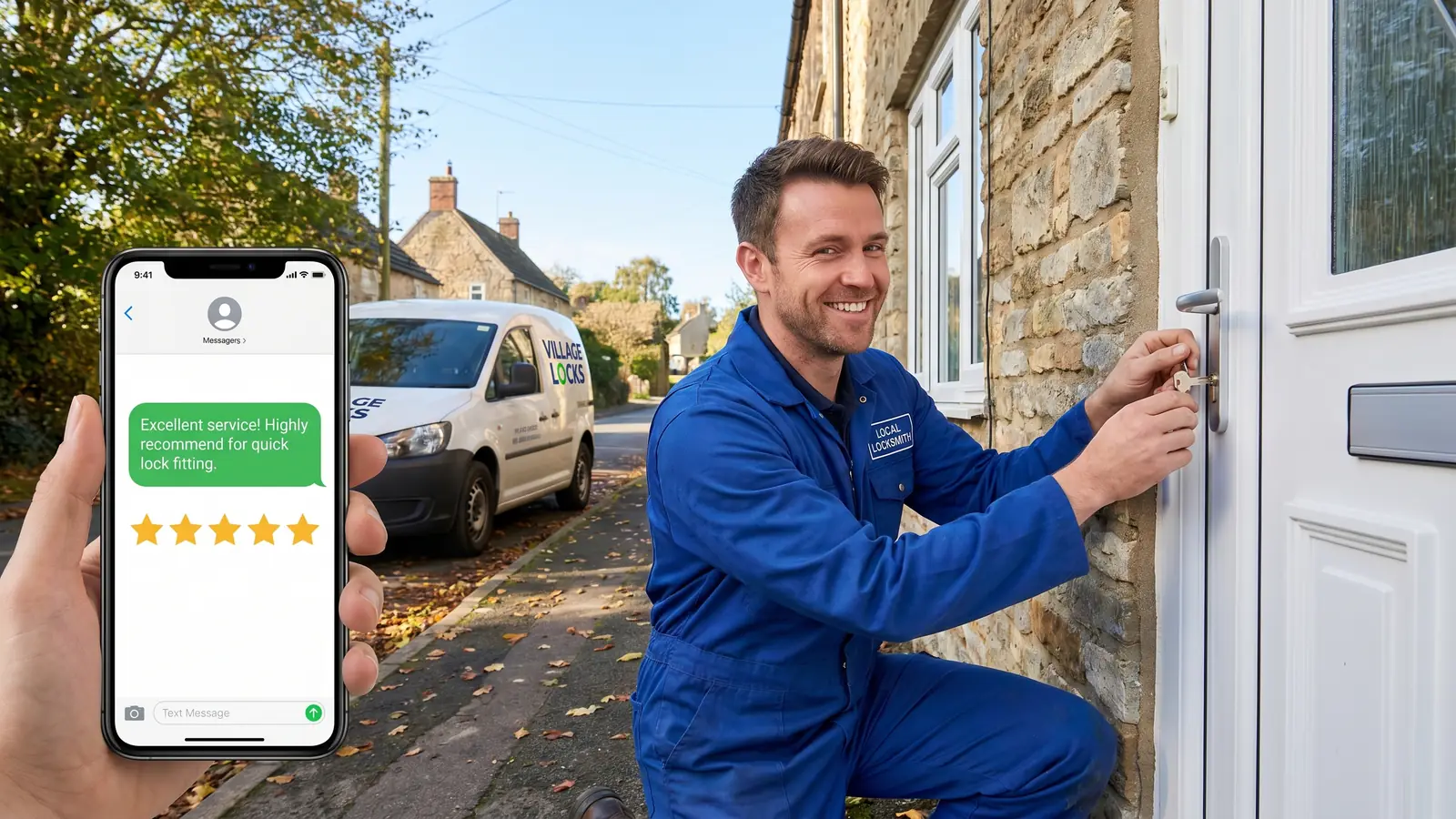
Sean left us a public 5-star review on Google. It is live at the time of writing.

The line that stays with us is the one in the middle: "not just how to make something look nice". That is exactly the brief we ran on the build. Looking nice is the easy part. Building something Google and AI engines can read, trust, and rank is the part most "web designers" never consider, and the part that produces the result on day 19.
The unguarded version of the same reaction landed by WhatsApp the night Sean first sat with the live site:
"Blimey mate it's so so good. If I came across this site I would think who on earth has done that. Absolutely incredible. The cross linking is mind blowing like a maze... but a simple one that is."
The "cross linking like a maze, but a simple one" line is the part worth holding on to. Internal links between the home, areas, the area pop-ups, the "About Sean" page, the FAQ, and the recent jobs are not decoration. They are how a small site signals topical depth to crawlers and AI summarisers. Done well, the visitor never notices the maze. The machines do.
What this proves about winning in 2026
Most "rank in ChatGPT" guides on the SERP promise three to six months and a long list of authority-building tasks: brand mentions across major publications, reviews on Trustpilot, optimisation for Bing, an established online presence. Lockerfella achieved a top result with none of those. The lever was not third-party authority. It was four things you can do on your own site:
- Non-commodity content, written from first-hand experience, with named places, named lock types, named jobs.
- Machine-readable identity at the root: the full nine AI Discovery Files, agreeing with the on-page schema.
- Schema on every page, validated, with zero errors.
- Speed that lets every page load in under two seconds on mobile, with zero layout shift.
If most of your competition publishes commodity content (and in local trades, most do), you do not need a year of link-building. You need a credible site that an AI engine can actually understand. The reward, as Lockerfella shows, can land in days rather than quarters.
The same principles apply if you are commissioning a build, redesigning an old site that has stopped ranking, or trying to undo the damage from a content programme that scaled the wrong way. We wrote a deeper post on the negative side of this story earlier in the week: E-E-A-T and Non-Commodity Content: What Google Actually Rewards Now. Read it as the companion piece to this one. If you would prefer a build-focused walk-through, our sister team at 365i wrote up the practitioner version on their own site after applying the same stack: How to Show E-E-A-T in 2026: A Non-Commodity Build Guide.
Want a website that AI engines and Google actually rank?
If you're commissioning a new WordPress site, or replacing one that has stopped working for you, the time to think about E-E-A-T, non-commodity content, schema, AI Discovery Files, and speed is before the build. Not after. We design and build sites the same way we built Lockerfella: opinionated, structured for both humans and machines, and deliberately easy to understand. If that's the kind of site you want, let's talk.
WordPress Design ServicesPublished: 28 April 2026 · Last reviewed: 4 August 2026 · Written by: Mark McNeece, Founder & Lead Developer, Press Forge
Editorially reviewed by: Mark McNeece on 4 August 2026 · Our editorial standards
Frequently Asked Questions
How long does it take to rank on ChatGPT?
Most rank-on-ChatGPT guides quote three to six months. Lockerfella did it in nineteen days. The difference is that we did not chase third-party authority signals. We built credible non-commodity content, structured identity at the root of the domain, and schema on every page from day one. AI engines only need a clear answer to the user's question. If your site has one and the rest of the web does not, the timeline shortens dramatically.
Do I need backlinks to rank in AI search?
No. Lockerfella ranked #1 on ChatGPT and Gemini with zero backlinks. Backlinks help, especially in classic Google organic. AI engines weigh content credibility and machine-readable identity more heavily than they weigh raw link counts. A small site with first-hand expertise, structured data, and a clean discovery layer can outperform a much larger site that has been gaming links for a decade.
Can a brand new website appear in ChatGPT?
Yes. A new domain with no history can surface in ChatGPT and Gemini within days if the content is non-commodity, the schema is sound, and the AI Discovery Files are in place. The "you need to be old and authoritative" assumption comes from classic SEO and does not transfer cleanly to AI search. Lockerfella was a 19-day-old domain when ChatGPT placed it first under "Local Brewood locksmiths".
What are AI Discovery Files?
AI Discovery Files are a set of standardised root-level files that tell AI engines who your business is, what you do, what you allow, and how to cite you. The full specification, drafted by Mark McNeece at AI Visibility, lists nine files: llms.txt, llms.html, ai.txt, ai.json, identity.json, brand.txt, faq-ai.txt, developer-ai.txt, and robots-ai.txt. Lockerfella ships all nine. They are part of why a brand-new site was understood quickly enough to be cited by name.
Does ChatGPT use Google rankings to pick businesses?
Partially. ChatGPT's web search layer leans on Bing, not Google, and overlays content credibility signals from training data, schema, and structured identity files. In Lockerfella's case, ChatGPT placed the site #1 even though it was only at position 3 on Google organic and not in the Google map pack. AI engines do not just mirror Google. They weigh different signals, and that is good news for small sites that publish honestly.
How does ChatGPT decide which businesses to recommend?
ChatGPT synthesises the answer from web search results, structured data, and content credibility signals. Strong inputs include: clear LocalBusiness schema with verified address and hours, a published llms.txt at the root, content with named first-hand experience, consistent identity across the site and the discovery files, and accessible page structure. Lockerfella satisfies every one of those, which is why it surfaces ahead of much larger lead-aggregator sites.
Will Lockerfella keep ranking, or is this a launch-effect honeymoon?
Honest answer: ranking will move. AI engines re-evaluate continuously, the GBP profile is being verified, and Sean is publishing slowly and writing about real jobs as they happen. The site has the structural foundations to ride out core updates without crashing, which is the durable win. We will keep monitoring and updating this article as the picture shifts.
Does this work for any local business, or only for niches like locksmiths?
It works in any niche where most rivals publish commodity content. That covers most local trades, most professional services, and most one-person service businesses. It does not produce instant wins in highly competitive money keywords (national insurance, casino comparisons, mortgages) where deeper authority matters and AI engines lean harder on legacy signals. The smaller and more specific the niche, the faster the win.
Sources
- Lockerfella AI Search Case Study - AI Visibility
- AI Discovery Files Specification - AI Visibility
- AI Visibility Explained: An Expert Q&A with Mark McNeece
- Google On Not Publishing Commodity Content (Danny Sullivan, Search Central) - Search Engine Roundtable
- Google Search Quality Rater Guidelines (PDF) - Google
- Creating helpful, reliable, people-first content - Google Search Central
- PageSpeed Insights mobile report for lockerfella.co.uk - Google
- How to Show E-E-A-T in 2026: A Non-Commodity Build Guide - 365i
- How we hit 97 mobile PageSpeed on managed WordPress hosting - 365i
- Lockerfella: 100 PageSpeed at launch case study - 365i
- He Asked for a Proper Locksmith Website. He Got Mission Control - 365i Web Design
- Sean Hamilton: The Full Lockerfella Interview - 365i Web Design
- Lockerfella - Sean Hamilton, Brewood locksmith
- About Sean - Lockerfella