
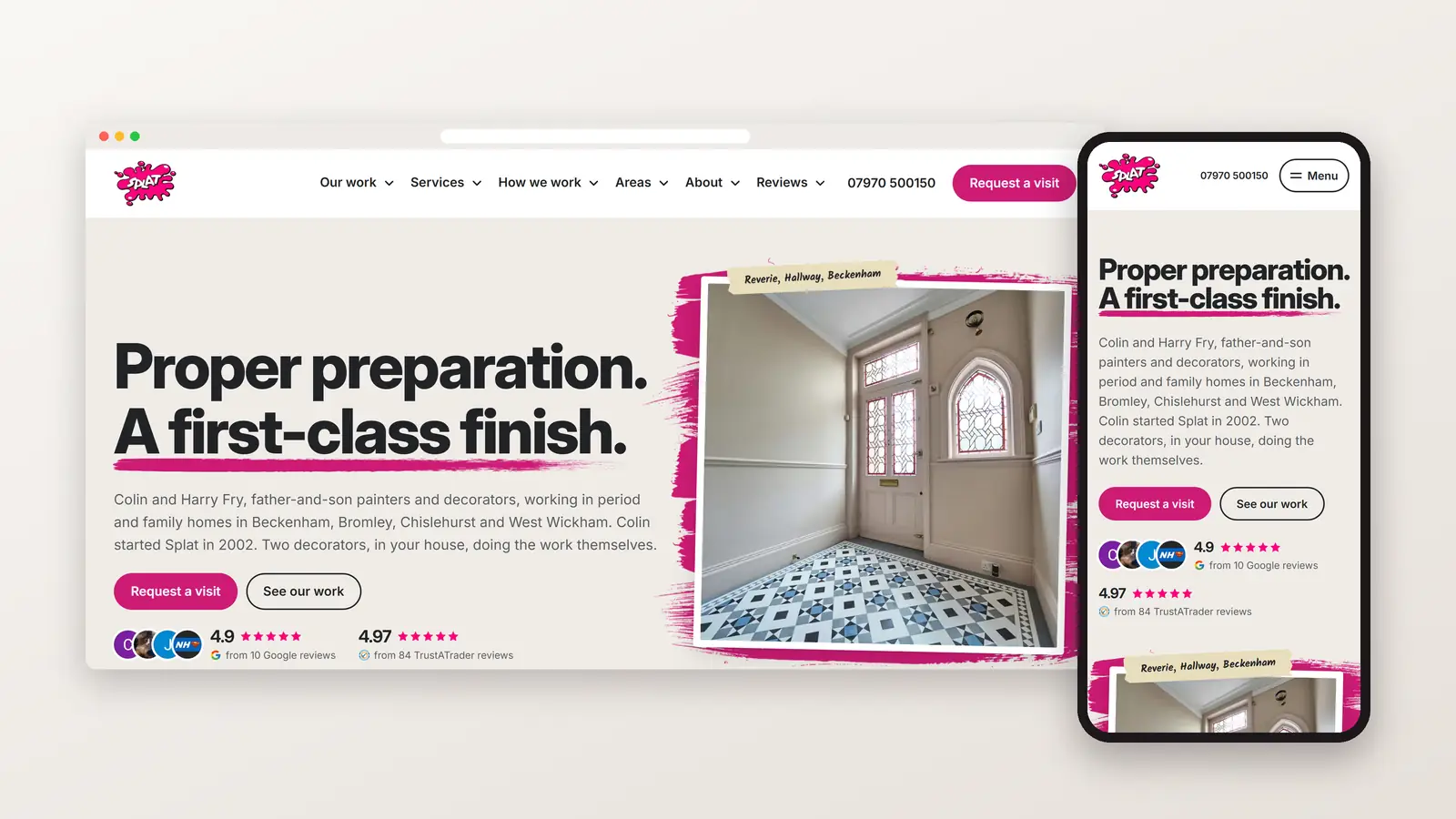
The Headline Numbers
- 854 real job photos, every one captioned
- 37 indexable pages, each 86% or more its own words
- 134 old URLs redirected in a single hop
- A+ security headers, 8 of 8 present
Most decorators want the phone to ring more. Colin Fry wanted it to ring less, for the wrong jobs. This painter and decorator website case study is about the site we built for him and his son Harry at Splat Decorating, who decorate period and family homes in Beckenham, Bromley, Chislehurst and West Wickham. When Colin first wrote to us, he said they weren't trying to compete on price. He wanted clients who value careful work, and a website that brings better enquiries rather than simply more of them. Everything that follows was built to that one test: prices that filter, 958 of his own photos, area pages written from real jobs on real streets, every review word for word, and a Google profile that no longer thinks Splat works 25 miles away in the wrong Hayes.
Splat Decorating: Better Enquiries, Not More of Them
Splat Decorating Ltd has been a limited company since 2002, and it is two people: Colin, who founded it, and Harry, who became a director in 2025. They work in the houses themselves. Their strapline, in Colin's own capitals, is "The company that DOESN'T live up to its name", and their pink splat logo is the joke: a decorator called Splat that never splats.
Colin found us as Press Forge. His enquiry arrived on a Saturday morning, and he was clear that he was putting the same brief to several agencies and comparing the answers like for like. So the proposal had to show we understood the business before it said anything about websites. Its stated goal, which I'd still sign today, was this: "When a homeowner in Beckenham, Bromley, Chislehurst or West Wickham who cares about a proper finish searches for a decorator, or asks an AI assistant to recommend one, Splat is findable, verifiable and obviously the right answer."
A few days later Colin asked us to drop an area he no longer works in, and a 14-page decision guide followed. Then the job began. The old site was replaced with a fast, hand-built one at the same address, and the rest of this study is about what the new one does. That includes the parts nobody sees: schema on every page and a set of AI Discovery Files, written to the AI Discovery Files specification, so an assistant asked about a decorator in Bromley has first-party facts about Splat to work from. We cover why that matters in what a local business website needs in 2026. One disclosure, in the spirit of our editorial standards: the site is hand-built PHP, not WordPress. Most of what we build is WordPress, and every decision here carries straight over to our painter and decorator website design work on that platform. It runs on 365i hosting, our sister company, which also handles Splat's billing and support.
From Enquiry to Live: Colin's Side of the Job
Every job has a client's view of it, and Colin's is the one worth dating. The card below is set out like a paint maker's colour card: the palest tint at his first email, the deepest shade of Splat pink the day it went live. Times come from the email thread and the project's history.
-
No. 01
3
Oct, Sat
- 11:59 Colin's enquiry reaches Press Forge. He is putting the same brief to several agencies and comparing them like for like. Our proposal goes back the same day.
-
No. 02
7
Oct
- Colin asks us to drop an area he no longer works in. A 14-page decision guide follows.
-
No. 03
13
Oct
- 09:03 Colin asks whether three garden buildings among his twelve flagship jobs is too many, and says he is happy to take our advice.
- 10:50 He agrees our suggestion: keep two, and swap the third for a hallway in Bromley.
-
No. 04
15
Oct
- 13:25 Ten photo questions, asked in his own folder names, all answered in one reply, one line each.
-
No. 05
17
Oct, Sat
- 06:32 Colin's "Final Tweaks" email: a short list, every item fixed that morning.
- 07:48 He starts the transfer of splatdecorating.com.
-
No. 06
19
Oct, Mon
- Live Live on www.splatdecorating.com, at the same address as before.
- Both domains move to 365i, and the mail moves with them.
- 20:00 A thank-you email from Colin, the evening it went live.
- 20:13 The first weekly Google Business Profile post. Eleven more are queued, one per flagship job, to 6 January 2027.
-
No. 07
20
Oct
- 07:48 Security headers raised from grade B to A+, 8 of 8 present.
- 08:32 A test enquiry through the live form arrives end to end on the new mail route.
-
No. 08
Still to come
- The first real Search Console figures, from mid-November, and the Bromley hallway write-up that replaces a garden flagship.
Only Colin's side of the job is dated. Times are UK time, from the email thread and the project's history.
Two things on that card matter more than the dates: how quickly Colin answered, and the last chip, which is still unpainted. The domains and the mail moved across the day the site went live, so what's left is the evidence: no ranking data exists yet. We don't colour in a chip before the paint is on.
Should a Decorator Put Prices on Their Website?
Most decorators don't, and the usual reason is fear of losing the job to someone cheaper. Colin's brief turned that round. He didn't want the job that goes to someone cheaper; he wanted the clients who were never going to choose on price. So the site publishes its starting points in plain sight, on the how we work page and in the menus: a room from around £1,000 plus VAT, and a hallway, stairs and landing from around £3,000 plus VAT. Underneath sits one honest line: "Starting points, not fixed prices. We usually take on two or more rooms, or a hallway, stairs and landing."
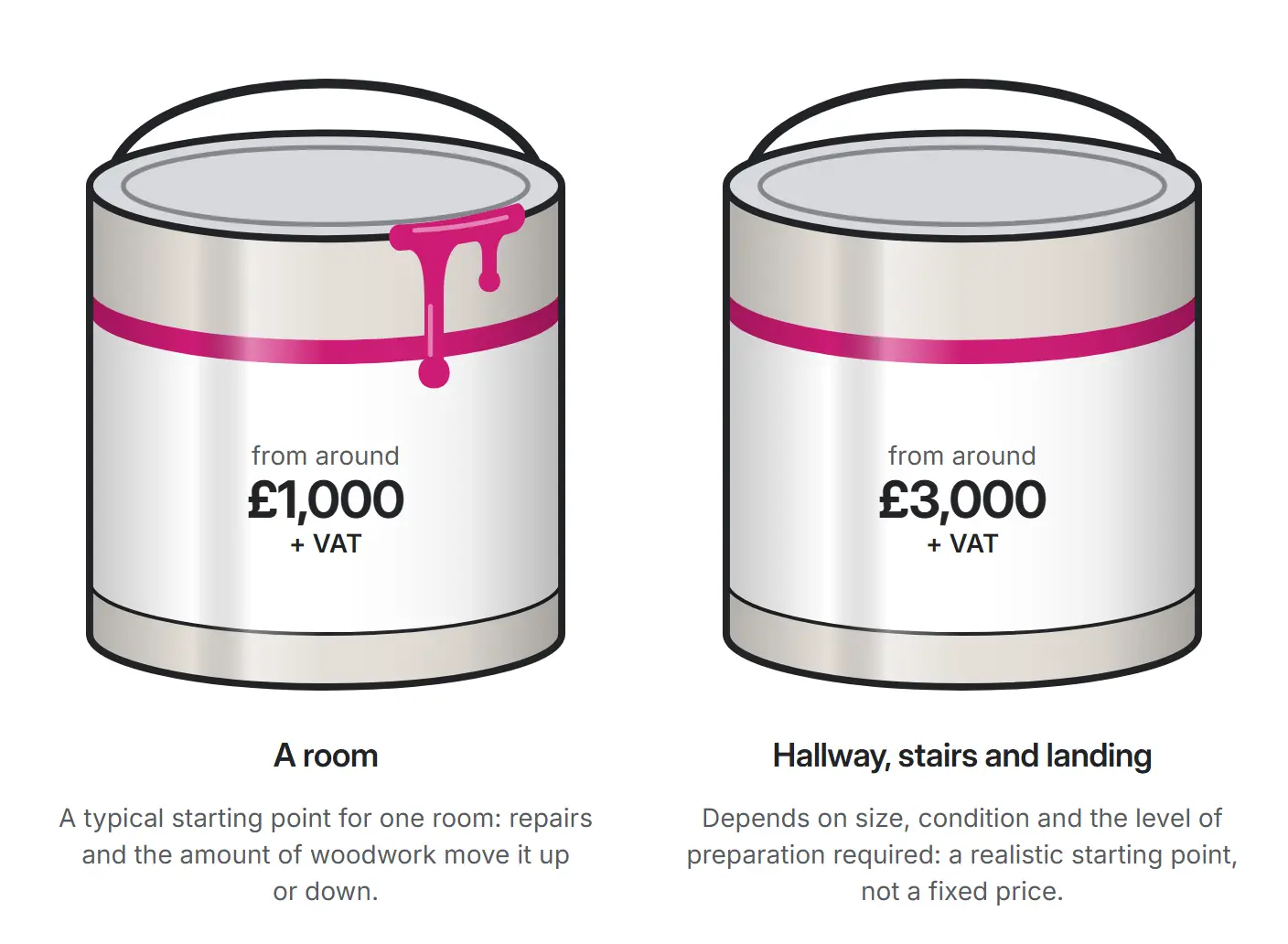
We considered three options: no prices, which is the trade norm; "competitive prices" copy, which says nothing; or honest "from" figures. The figures won, and the words that pull the other way went with them: "affordable", "cheap", "competitive prices" and "no job too small" are banned across the whole site. The same two prices went into the From fields of Splat's Google Business Profile, so a homeowner sees the same numbers wherever they find Colin. The enquiry form also asks "How did you find us?", because it's the first thing Colin asks every new enquirer anyway.
Has it worked? I can't tell you yet, and I won't guess. Enquiry numbers are private to Colin and Harry, and a few days of data would prove nothing either way. What I can say is that the decision is made in the open, and that a homeowner who wants a bedroom repainted for £300 now finds that out from the site rather than from a wasted visit.
958 Camera Originals: Real Photos on a Decorator Website
The first version of the site used the small, compressed photos Splat already had online. Then Colin sent the originals: 958 of them, in 49 folders he had named himself, things like "A Cabin in Vert De Terre, Beckenham" and "Pebbledash painted properly on a tall house in Orpington". A decorator's best marketing asset is their own camera roll, and this one was years of careful work with a paint colour against nearly every job.
Rather than start again, we treated the originals as replacements. A script matched each one to the old photo it replaced, so 548 sharper copies inherited every caption, privacy box and before-and-after pair already written, and 133 new photos were captioned after looking at each one. That left 333 questions. We closed 207 ourselves, decided 101 without bothering Colin, and sent him ten in one email, written in his own folder names. He answered all ten the same afternoon. The red on a Beckenham front door turned out to be a Dulux colour code with no name at all. And question ten, which purple was a pair of painted bedside tables? Farrow & Ball Pelt, came the reply: "they are my own bedside tables". They stayed out of the portfolio.
The home page shows why the originals mattered. Its paint chips aren't flat swatches: each is cut from a photo of a real wall, because photographed paint never matches a printed chip and a decorator's clients know it. Choose a chip and the main photo changes to the job that colour was used on, with the maker and the room named underneath.
Privacy took the most judgement. Our first pass blurred anything that might identify anyone, and fogged far too much. The rule we settled on blurs only what protects a client: house numbers, car plates, people and family photos. That removed 28 blurs and kept 78, and seven photos a blur would have spoiled were cropped or dropped instead. Where a blur stays, it destroys the detail rather than softening it.
The result is 854 photos on the live site, each served as AVIF and WebP at up to five widths and each with a caption written by someone who looked at it. The median photo at 800 pixels wide weighs 38 KB, and one 13 MB original became a 16 KB page image. Our speed optimisation guide explains why that matters.
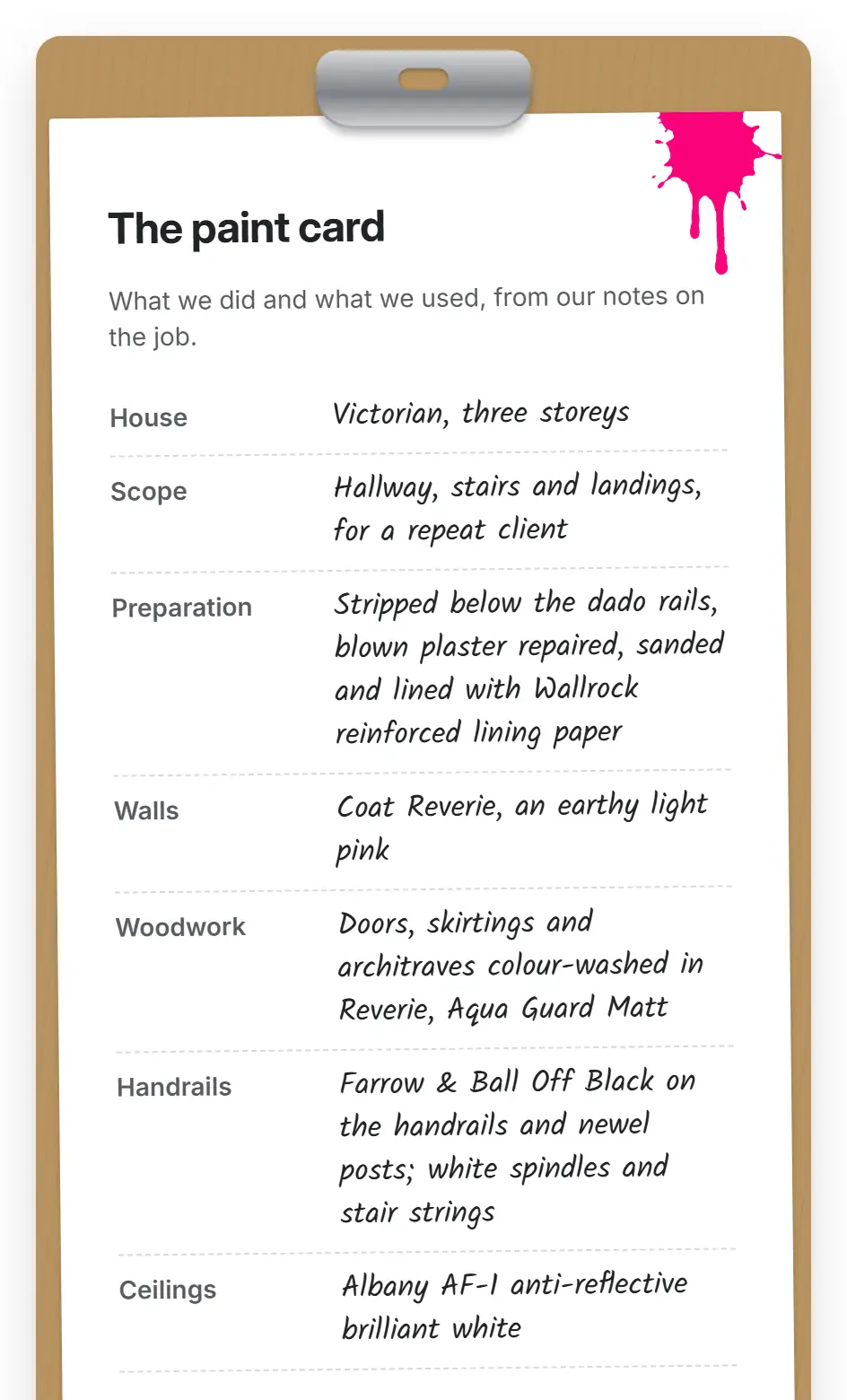
The work pages make the most of it. On the Victorian hallway in Beckenham, a before-and-after slider takes the same viewpoint from stripped plaster to the finished Coat Reverie walls. Beside it sits a paint card in the style of a clipboard job sheet: the house, the scope, the preparation and every product and colour, from the Wallrock lining paper to Farrow & Ball Off Black on the newel posts.
When Colin saw what we had done with his photos, he wrote back the same afternoon:
"Love your work and enthusiasm, attention to detail, the way that you've managed to convey our brief into a stunning visually and informative website is simply incredible!! I've never seen anything like this or anywhere near as impressive."
Colin Fry, founder and director of Splat Decorating, by email on 15 October 2026 (his "assertion" corrected to "attention")
I'm quoting that for what it says about the method. What Colin noticed was that the site described his work the way he would, and that only happened because every caption was written after looking at the photo and every question we asked used his own words. Ask a tradesman something he can answer in one line from memory and he will. Ask him to fill in a spreadsheet and the photos sit in a folder for another year. That is the difference between a painter and decorator website that sells the work and one that merely shows it.
Area Pages for Painters and Decorators That Aren't Doorways
Local area pages are where most trade websites go wrong. The usual shape is one page per town with the name swapped in, and Google has a name for it:
"Doorway abuse is when sites or pages are created to rank for specific, similar search queries. They lead users to intermediate pages that aren't as useful as the final destination."
Google Search Central, Spam policies for Google web search, which gives "pages targeted at specific regions or cities that funnel users to one page" as an example
The test in that definition is usefulness. A town page earns its place if a homeowner there learns something they couldn't learn anywhere else on the site, so we set a measurable rule: every page must be at least 80% its own words, checked by a script that compares runs of eight words across the whole site. Then every service and area page was rewritten from job material no other page had used. No project, review quote or featured photo appears on two pages, and each of the 72 margin doodles appears exactly once.
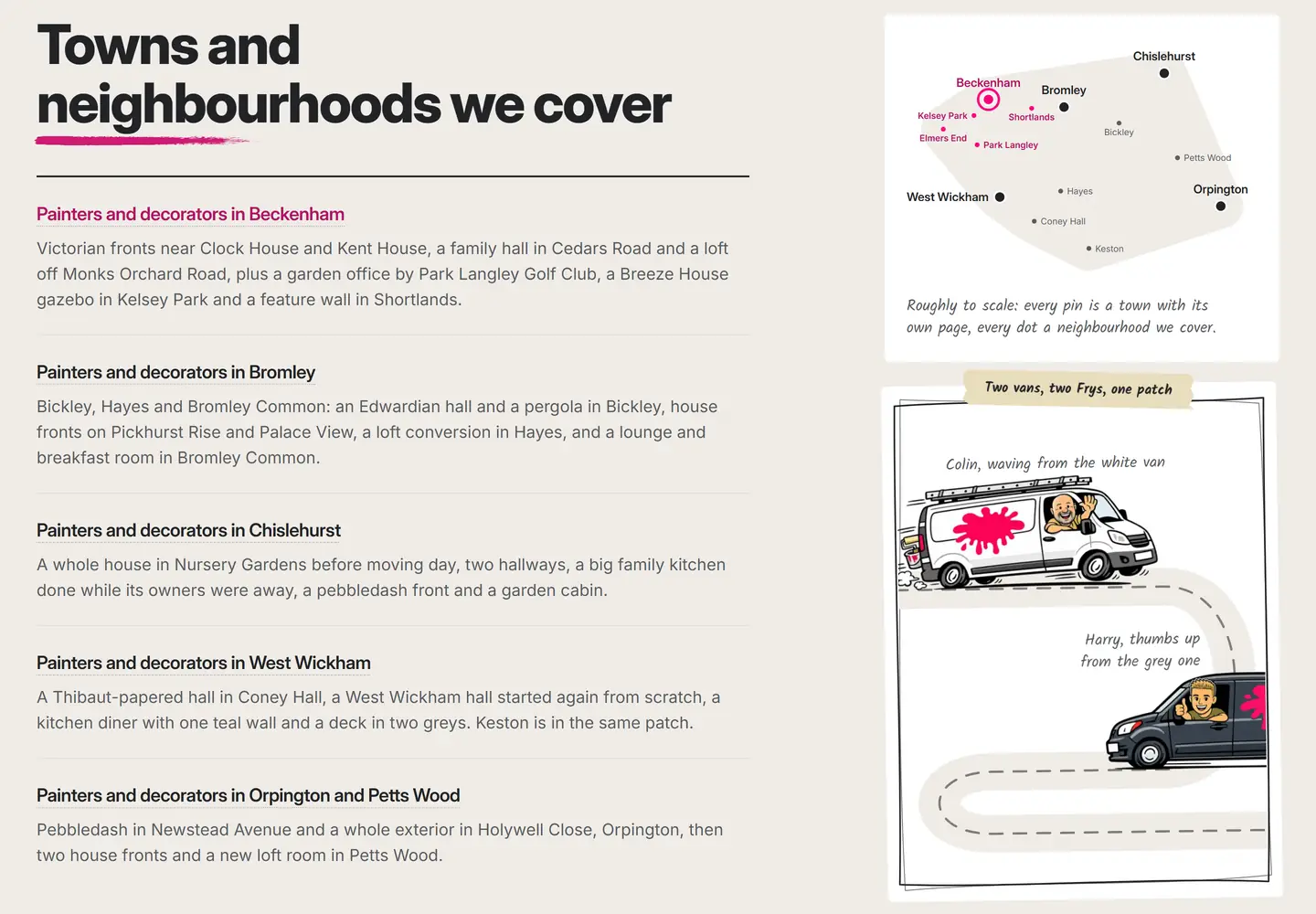
The result reads like a decorator talking about his patch, because it is. The Beckenham page names Victorian fronts near Clock House and Kent House, a family hall in Cedars Road, a garden office by Park Langley Golf Club and a feature wall in Shortlands. Bromley gets an Edwardian hall in Bickley and a loft conversion in Hayes. Colin also asked us to stop describing his areas by distance and simply name them, so phrases like "as far out as we travel" were swept from every page. He wanted every town to feel local, and now it reads that way.
Re-measured on 20 October 2026, all 37 pages pass. The area pages run from 89.4% to 95.9% their own words, and the colours page reaches 98.8%. That's how a decorator website covers five towns without a single doorway page. We explain the wider thinking in why Google rewards non-commodity content.
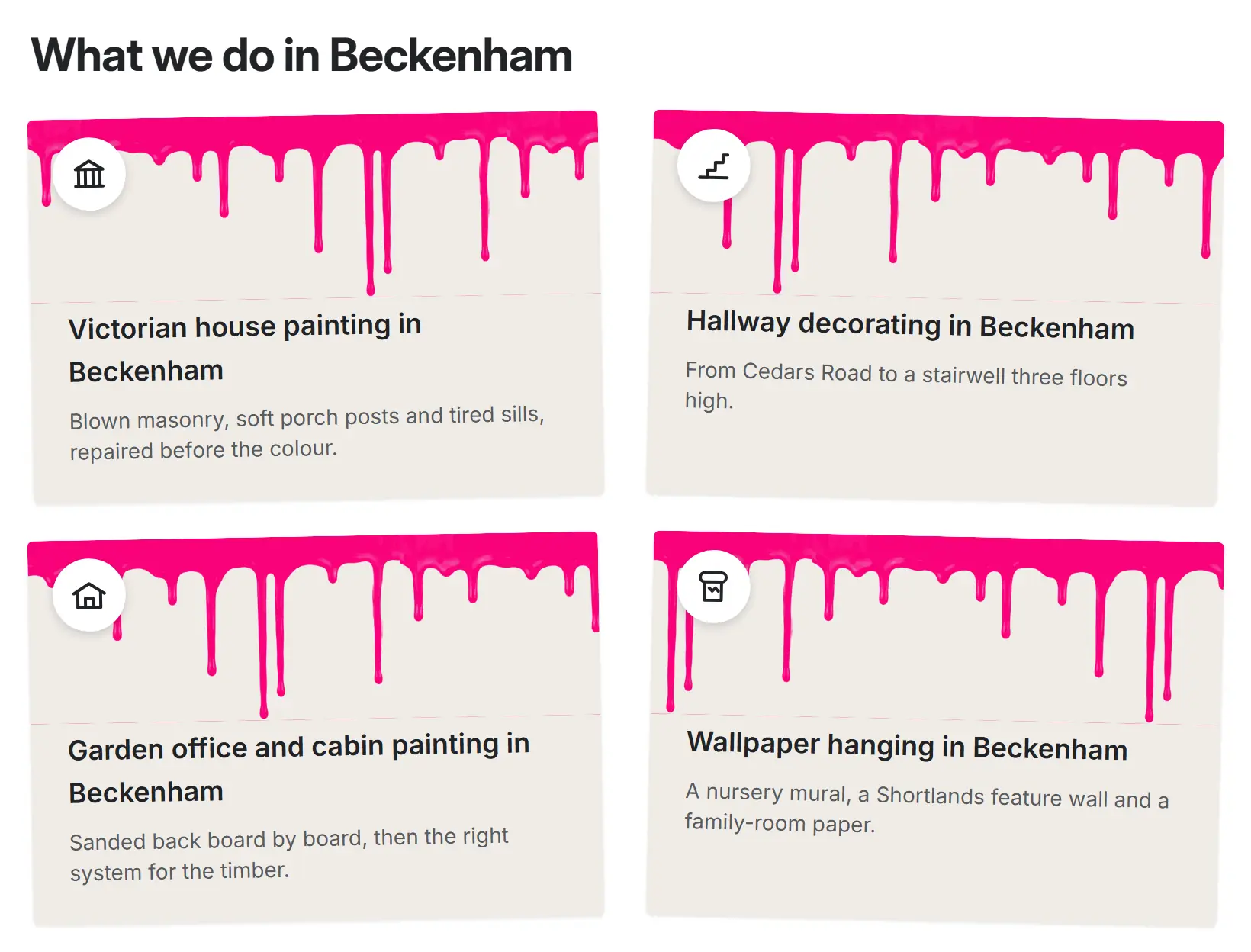
The vans on the areas page are an illustration, drawn from a photo Colin sent, and they drive in from either side as you scroll down to them. Colin saw them first on the staging site:
"What a lovely thing, utterly brilliant! Harry and I are in the cafe and love the way the vans drive in on the image!"
Colin Fry, by email on 17 October 2026
Nobody hires a decorator because of a drawing of a van. But a homeowner about to let two people into their house for a fortnight wants to know who those people are, and the vans say it in one look: father and son, two vans, one patch.
Google and TrustATrader Reviews, Word for Word, With No Star Markup
On a painter and decorator website, reviews do more selling than any copy we could write, and Splat's reputation was already strong: 4.97 out of 5 from 84 reviews on TrustATrader, and 4.9 from 10 on Google, as of 19 October 2026. The proposal promised review-rating markup to go with it, the structured data that can put gold stars beside a search result. We built it, and then we took it out. Google's own guidance is unambiguous about who those stars are for:
"If the entity that's being reviewed controls the reviews about itself, their pages that use LocalBusiness or any other type of Organization structured data are ineligible for star review feature."
Google Search Central, Review snippet structured data, which also says "Don't aggregate reviews or ratings from other websites"
Read those two lines together and the markup has no upside. Splat's reviews live on Google and TrustATrader, and copying them into Splat's own schema is both aggregating from other websites and a business marking up reviews about itself. The stars would never show, and the markup would claim something the page isn't entitled to. Google's 2019 announcement of the rule is clear that the page simply becomes ineligible; there's no penalty to fear, just nothing to gain. So all 131 Review nodes and both AggregateRating nodes came off the reviews page, and the site's schema check now fails a deploy if any return. We made the same call on Tickdoc.
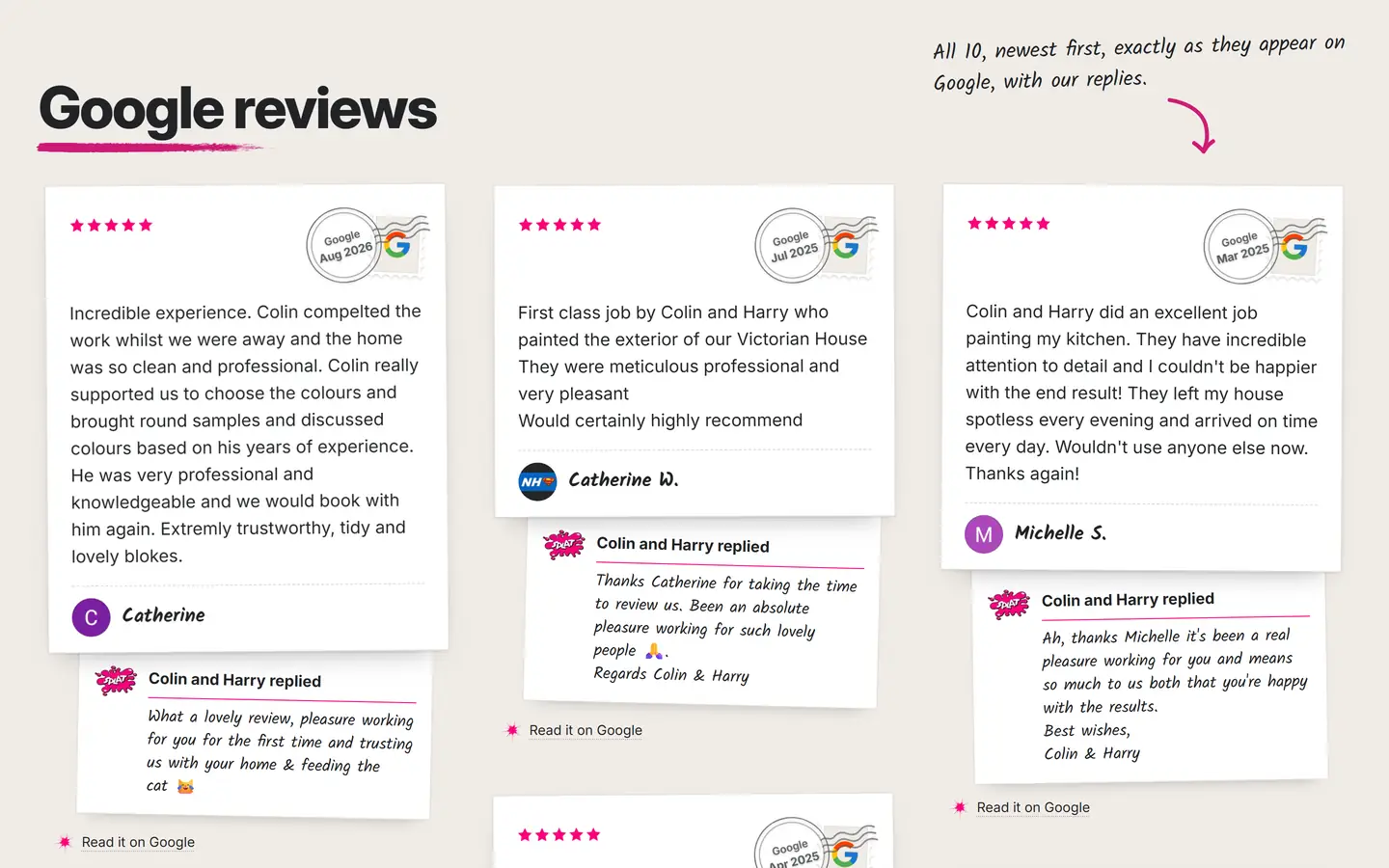
The reviews themselves stay on the page as plain text, every one of them word for word, typos included. Google reviews sync weekly through the Business Profile API, with Colin and Harry's replies shown on a slip under each one. TrustATrader reviews sync weekly from the public profile, and that sync refuses to write if anything looks wrong: nothing parsed, fewer than 90% of the reviews we already hold, or a headline rating that doesn't match. A sync that fails loudly is better than a reviews page that quietly empties. One small win along the way: Colin's replies went from 9 of 10 Google reviews to 10 of 10 after we pointed out the one he had missed.
The Google Business Profile Audit: The Wrong Hayes
As far as Google knew, Splat Decorating covered a patch of west London it had never worked in. Nobody had been through the Google Business Profile properly in years, which is normal for a busy two-person firm, and profiles drift. Before changing anything, we saved a full copy of the profile as a rollback point, then checked every service area by name and coordinates through Google's Places data. That's where the best find of the job turned up. The profile listed "Hayes", and Splat does work in Hayes, the one in Bromley. The place on the profile was Hayes in Hillingdon, about 25 miles away on the other side of London.
| Field | Before (14 Oct) | Now (20 Oct) |
|---|---|---|
| Name | Business name plus the strapline | Splat Decorating Ltd |
| Categories | 1: Painter | 3: Painter, Interior Decorator, Wallpaper installer |
| Service areas | 18, including two areas Colin had dropped, the wrong Hayes and a dead Shortlands ID | 17, each checked by name and coordinates |
| Services | 62, none described; Google's view showed 78, including 16 it had made up | 23, all described, two with "from" prices |
| Hours | Monday to Saturday | Monday to Friday, plus Christmas closures |
| Address | Registered office shown publicly | Hidden, as a service-area business (in Google's moderation) |
| Posts | None | Weekly from 19 October, one per flagship job |
The other finds were just as typical. The Shortlands place ID had died, and Google had dropped it without saying so. The services list included commercial and insurance work Colin no longer takes on. And Google had added 16 services of its own, with names like "Exterior Exterior Painter". One trap is worth knowing if you ever edit a profile through the API: saving the services list replaces the whole list, so a patch that only adds new services quietly deletes everything else. We fixed what the facts already supported one field at a time, and held the name, the address and the extra areas until Colin had replied in writing. He sent back a tick or a cross against every service over a morning coffee.
The address needed more thought. Splat's registered office sits outside the towns it works in. The law still requires the company details to appear, so the address is shown only where it has to be, on the privacy, terms and contact pages, while the footer carries just the company name and number. Schema lists only the real towns, old pages about the dropped area return 410 Gone rather than a redirect, and on Google the address is hidden. Google's own guidelines say it plainly: "If you're a service-area business, you should hide your business address from customers." That change was still in Google's moderation queue on 20 October, so I won't call it done.
A Decorator Enquiry Form That Books a Visit, and the Email Behind It
The enquiry form is where a painter and decorator website earns its keep. Colin quotes only after he has seen the job, so the form doesn't pretend to quote: it books a visit. The job enquiry pad asks what you'd like done, by ticking cards for hallways, rooms, whole floors, exteriors, wallpaper, garden buildings or kitchens, then the house and the timing, a rough budget band, and up to five photos. Beside it sit the two starting prices, the hours, and the line "Usually booked 4 to 8 weeks ahead", which filters as well as any price.
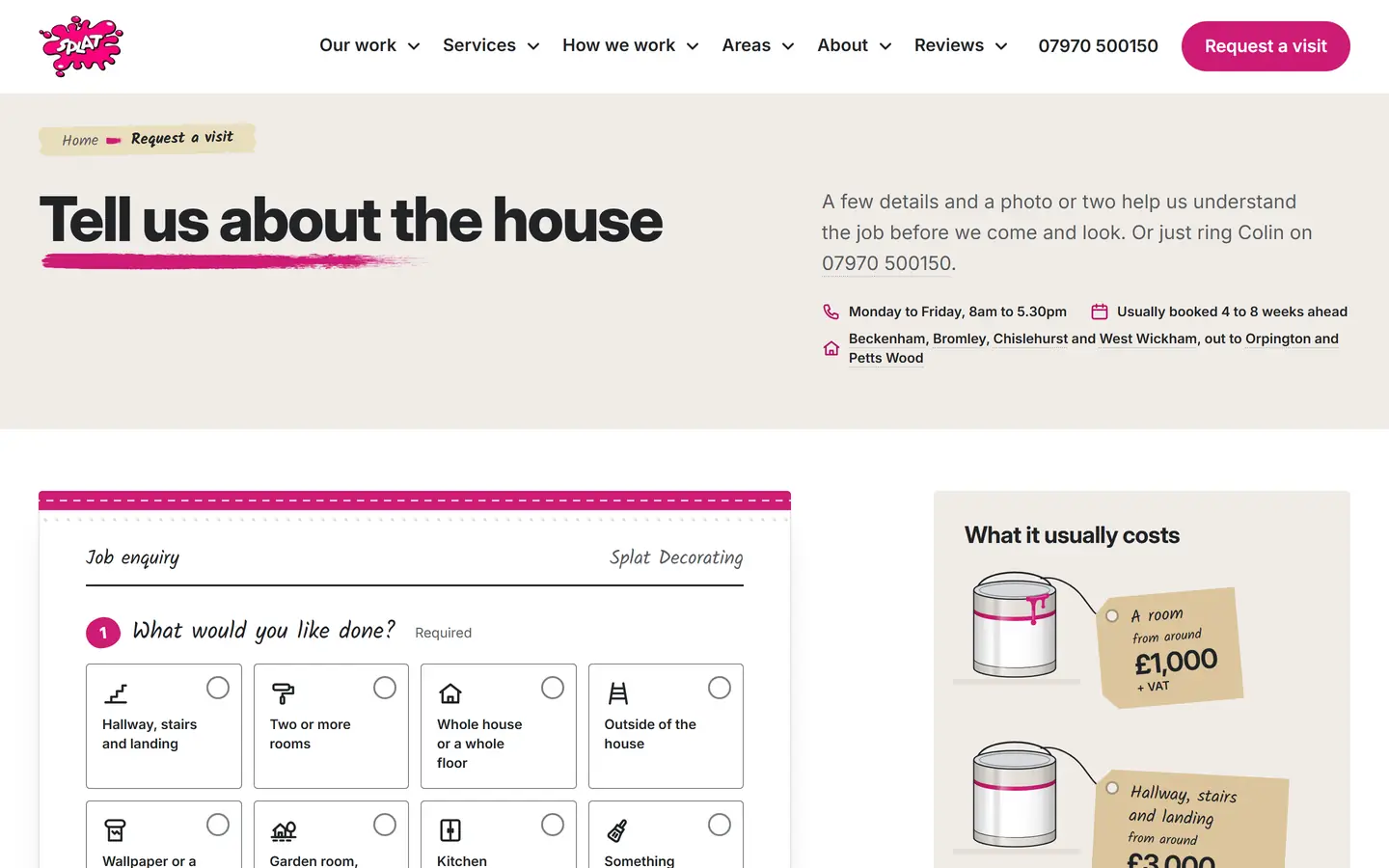
The spam protection shows no puzzle. Google reCAPTCHA v3 loads only when someone starts the form, so it costs nothing on page load, and on the server there's a honeypot field, a signed timing token and a rate limit. The rule that matters most was in Splat's project notes from the first day: every spam trip is logged, never silently dropped. I wish I could say we followed it everywhere. A few days later, the MC Transports form we built dropped trapped messages silently, and browser autofill sent four of the owner's real test enquiries into the bin while the form said "sent". Splat's rule is now the rule on every form we build. The enquiry emails, both Colin's copy and the customer's confirmation, are designed in the site's own look and built to render properly in Outlook.
Behind the form sits an admin area for Colin that wasn't in the original proposal: an enquiry log, a preview of every email before it goes, a button to refresh the reviews, and a Get Reviews screen that sends a finished client a thank-you from Colin and Harry with buttons straight to Google and TrustATrader. Sign-in uses Argon2id passwords or Google. Enquiries are deleted automatically after 12 months and their photos after 90 days, exactly as the privacy policy says.
The email move is the part a decorator would never think about, and the part most likely to lose them a job. splatdecorating.com publishes a DMARC policy of p=reject, and its SPF record allowed only the old provider's servers, so a test message from the new host failed SPF, carried no DKIM signature and was refused by Gmail. Sending as the domain before the records changed would have bounced real enquiries. So the site sent through the 365i sender until the cutover, every test enquiry went to our own inbox marked as staging, and the DNS changes ran in a fixed order. Both domains and the mail moved to 365i on 19 October, the day the new site went live. The domain now lists only the new mail servers in SPF, with a hard fail for anything else, DMARC stays at p=reject, and the next morning a test enquiry through the live form arrived end to end. One more lesson for any trade business: older mail had been downloaded by POP3 and now lives only on Colin and Harry's devices, so no server copy can bring it across.
What We Got Wrong on the Splat Build, and What Colin Caught
Our case studies promise to publish what didn't work as well as what did. Three of ours, then Colin's.
Content cut off on small phones. A friend testing the site on a 360-pixel phone told us the home page headline was clipped. Our checks said no page scrolled sideways, and they were right, which was the problem: the main content area hid anything too wide instead of letting it scroll, so the check could never fail. A new check loads every page in the sitemap at four phone widths and flags anything past the edge of the screen. It found 362 problems on its first run. It finds none now, and it runs before every deploy. Test what a visitor sees, not the number a tool reports.
A house number we missed. While building the share cards for each page, we spotted a house number readable in two photos, outside the blur that should have covered it. The blur boxes were moved, and a new tool now shows every blurred photo whole on one sheet, so a misplaced box is obvious at a glance. We rechecked 79 photos with it.
Live at grade B. On the morning after launch, I ran the site through 365i's HTTP header checker and it scored a B, 70 out of 100. HSTS was still switched off, as our starter template ships it until https is confirmed on the live domain, and two other headers were missing. All three were added that morning, with one subtlety: the admin area keeps a looser cross-origin opener policy, because Google sign-in runs in a pop-up that the strict setting would break. The site now scores A+, with all eight security headers present.
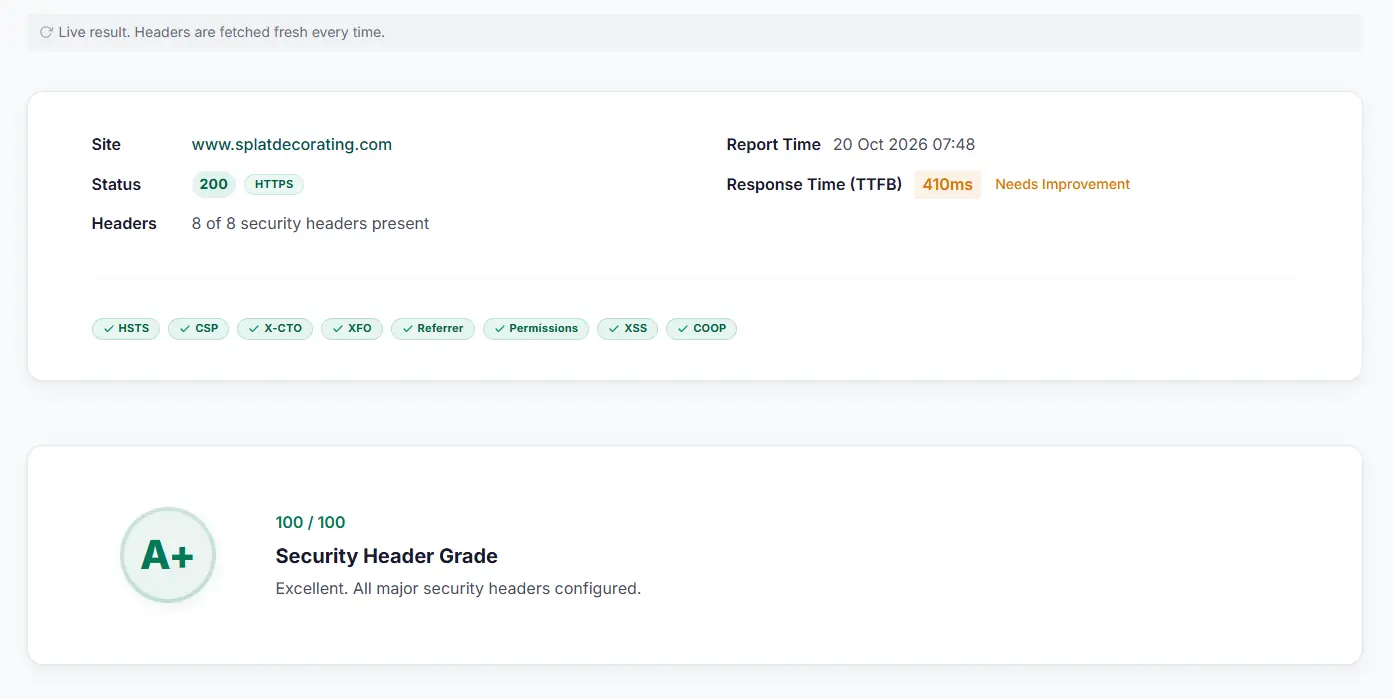
The Content Security Policy deserves a mention, because the grade alone doesn't prove much. Splat's policy allows no unsafe-inline for scripts or styles, and the one small inline script the site needs is allowed by its SHA-256 hash rather than by a blanket exception. The only outside sources are Google's reCAPTCHA paths.
Colin's catches. Colin checked the staging site the way he checks a finished room. He found gallery links that opened at the top instead of at the job, two home page paint chips that opened the same job (the deck became six chips from six different jobs), and an FAQ quoting a single 4.83 review that read as if it were his overall score. Each was fixed and logged. He also asked whether three garden buildings among his twelve flagship jobs was too many. We counted: four hallways, two interiors, a kitchen, two exteriors and three garden buildings, with Bromley, his biggest town, on only one. We suggested swapping one garden job for a Bromley hallway, and he agreed within the hour. That write-up waits on his notes and photos, so the garden cabin is still on the site today.
Working With Colin and Harry Fry
I want to say plainly that this was one of the most enjoyable jobs I've done, and here is why, with the evidence.
Colin is funny. His emails are full of it. After a morning of small changes he wrote: "Appreciate all those little changes, even though it means you've got sticky bacon fingerprints all over your keyboard now." He answers clearly and quickly, too: the ten photo questions came back in one reply, and the Google profile checklist came back with a tick or a cross against every line. He takes real pride in the work. Nobody files 958 photos into folders named after the job and the paint unless they care how it looks.
He was also open to ideas he hadn't asked for: 72 margin doodles of the tools of the trade, each with a line in his voice, the two vans, the admin area, and a 15-second teaser trailer for his Facebook page, all made by 365i for Splat Decorating. The trailer tells the company joke in one shot: a tin of hot-pink paint topples off a stepladder towards a freshly painted Victorian hallway, splats, and then rewinds back into the tin, because Splat doesn't splat. Colin posted it the same morning. And he took advice when it was given, as the garden swap shows. Most of all, Colin has the same eye for detail I try to bring to a build. He found faults in the staging site that I'd missed, he cared whether every area sounded local, and he told me when something didn't sound like him. That's a client who makes the work better, and it shows on the page.
What This Painter and Decorator Website Case Study Can't Claim Yet
The new site went live on 19 October 2026, the day before this study was written. Here is everything we can measure honestly so far.
- Search Console: the home page, the areas page, a case study and a service page were all "Submitted and indexed" on 19 October, with canonicals Google agrees with. No new page has registered a search impression yet, and the data lags about three days. The property's older figures belong to the old site, so we don't publish them.
- Lighthouse: run against the live site on 20 October 2026 (version 12.8.2, default throttling), five pages scored 100 for accessibility, best practices and SEO, and 100 for desktop performance. Mobile performance ran from 95 on the home page to 99, with no layout shift.
- Security headers: A+, 100 out of 100, 8 of 8 headers, on 365i's checker.
- Accessibility: 30 of 30 checked colour pairs pass WCAG 2.2 AA, measured rather than estimated. Splat's logo pink measures 3.95:1 on white, which fails for body text, so it is kept to fills and large marks, and pink text uses a deeper shade at 6.70:1. We wrote about that trap in your brand colours probably fail accessibility.
- Redirects: 177 old URLs mapped one by one: 134 redirect in a single hop to the page that really replaces them, 38 answer 410 Gone, and 5 stayed where they were. Not one goes to the home page by default. That discipline is the core of our WordPress migration service.
| Page | Mobile performance | Desktop performance | Accessibility, best practices, SEO | Mobile LCP | CLS |
|---|---|---|---|---|---|
| Home | 95 | 100 | 100, 100, 100 | 2.7 s | 0 |
| Areas | 99 | 100 | 100, 100, 100 | 2.2 s | 0 |
| Victorian hallway case study | 98 | 100 | 100, 100, 100 | 2.3 s | 0 |
| Hallways service page | 98 | 100 | 100, 100, 100 | 2.2 s | 0 |
| Request a visit | 99 | 100 | 100, 100, 100 | 1.8 s | 0 |
Most painter and decorator website case studies stop at a screenshot, and this one has to stop short of results too. The home page is 95 on mobile, not 100, because it leads with a large photo and a deck of real paint chips, and we'd rather keep them than chase the last five points. Chrome's field data will mostly reflect the old site until mid-November, and there are no rankings, enquiry figures or AI citations to report yet. We won't invent any. When real figures arrive we'll add them here, dated, whichever way they point. That's the standard we hold Lincolnshire Chauffeur Services and Tickdoc to as well, and the reason we wrote about whether ChatGPT recommends local businesses rather than promising that it will.
Results log
- Published. New pages indexed; no Search Console impressions yet. Security headers A+; Lighthouse mobile 95 to 99 across five pages, desktop 100.
Next measurement from 16 November 2026, once Search Console has new-site data.
Frequently Asked Questions
Should a painter and decorator put prices on their website?
Splat Decorating does, as starting points: a room from around £1,000 plus VAT, and a hallway, stairs and landing from around £3,000 plus VAT, with a line saying they usually take on two or more rooms. The aim is to filter enquiries rather than attract more of them. Someone looking for the cheapest repaint of one bedroom moves on, and the people who do get in touch already know the scale of job Colin and Harry take on.
Can a decorator use their own phone photos on a website?
Yes, and they are the best photos a decorator has. Colin Fry sent 958 camera originals in 49 folders he had named himself. Each was matched to the photo it replaced or captioned as new, then published as AVIF and WebP at up to five widths. A 13 MB original became a 16 KB page image. House numbers, car plates and people were blurred so heavily they cannot be read, and anything a blur would have spoiled was cropped or left out.
Does a decorator need a separate page for every town they cover?
Only for the towns they genuinely work in, and only if each page is written from real jobs there. Splat has pages for Beckenham, Bromley, Chislehurst, West Wickham, and Orpington and Petts Wood. Each one names real streets and real jobs, and a script checks that every page is at least 80% its own words. On 20 October 2026 the lowest area page scored 89.4%. Pages that swap a town name into a template are what Google calls doorway abuse.
Should my Google and TrustATrader reviews get star markup on my website?
No. Google says a business that controls the reviews about itself is ineligible for star review features, and that reviews should not be aggregated from other websites. Splat shows every Google and TrustATrader review word for word, synced weekly, with Colin and Harry's replies, and carries no Review or AggregateRating markup at all. A deploy check fails if any comes back.
What is usually wrong with a decorator's Google Business Profile?
On Splat's profile we found a strapline in the business name, a service area called Hayes that was really Hayes in Hillingdon about 25 miles away, a dead place ID Google had silently dropped, Saturday hours Colin does not work, the registered office on public display, and 62 services with no descriptions, including work he no longer does. Google had also added 16 services of its own, such as "Exterior Exterior Painter".
My registered office is outside the area I work in. Does that hurt?
It can, if the address is treated as a place you serve. Splat's registered office sits outside its working area, so the address appears only where the law requires company details, the footer carries the company name and number, schema lists only the real towns, old pages about that area return 410 Gone, and the Google profile is set as a service-area business with the address hidden, as Google's own guidelines advise.
Will moving a decorator's website move their email too, and could mail be lost?
Not automatically. Splat's domain publishes DMARC p=reject, so sending as the new host before the records change would have been refused by Gmail. We kept the site's mail on the 365i sender until the cutover and ran the DNS changes in a fixed order, and both domains and the mail moved to 365i on the day the new site went live. We also found that older mail had been downloaded by POP3 and lives only on the owner's devices, so no server copy can bring it over.
How do you stop form spam without annoying real customers?
Splat's enquiry form shows no puzzle. Google reCAPTCHA v3 loads only when someone starts filling the form in, and the server checks a hidden honeypot field, a signed timing token and a rate limit. Every spam trip is logged, never silently dropped, because a trap that fails quietly can bin a real customer, which is exactly what happened on a later build that skipped the rule.
Want Better Enquiries, Not Just More?
If your work is better than your website, we'll build you one that shows it: your own photos, prices that filter, area pages written from real jobs and a Google profile that's actually right. Tell us about your business and we'll quote within 24 hours.
Get a Free QuotePublished: 20 October 2026 · Last reviewed: 20 October 2026 · Written by: Mark McNeece, Founder & Lead Developer, Press Forge
Editorially reviewed by: Mark McNeece on 20 October 2026 · Our editorial standards
Sources & Evidence
- splatdecorating.com - the live site
- Splat Decorating, how we work and how we price
- Splat Decorating, the areas they cover
- Splat Decorating, reviews in their clients' own words
- Splat Decorating on TrustATrader
- Splat Decorating Ltd at Companies House
- Spam policies for Google web search - Google Search Central
- Review snippet structured data - Google Search Central
- Guidelines for representing your business on Google
- Google Business Profile APIs
- reCAPTCHA v3 - Google for Developers
- Understanding Success Criterion 1.4.3: Contrast (Minimum) - W3C
- 365i HTTP header checker
- AI Discovery Files specification - AI Visibility Definition
