
The Headline Numbers
- 100 mobile PageSpeed, all four categories
- 10 of 12 articles the client corrected before launch
- 48 of 48 colour pairs passing WCAG, measured
- 19 automated quality gates in one command
This accountant website case study is about a practice whose whole offer rests on its numbers being right, and a website that had to live up to that. Tickdoc is an accounting practice in Eastleigh, Hampshire, run by its founder and director, Sibo Armstrong. We replaced its old WordPress site with a fast, professional, hand-built one: 22 pages and 12 articles, every figure checked against GOV.UK, and 100 in all four PageSpeed categories on mobile. None of that is the part I most want you to read, though. The part worth reading is that Sibo reviewed every article and every page herself before launch, and ten of the twelve articles came back with corrections. The site went live at the start of October 2026, so the ranking verdict is months away. We say so, and we show you the baseline it has to beat.
Tickdoc, an Accounting Practice in Eastleigh
Tickdoc Ltd was incorporated in September 2014. It does accounts, tax, VAT, payroll, CIS and bookkeeping for small businesses and owner-managed limited companies, mostly in Eastleigh, Southampton, Winchester and across Hampshire, with clients elsewhere in the UK as well. Health and social care is its biggest sector, with construction close behind. Its eight Google reviews average 4.9, and Sibo has replied to every one of them.
The idea that sets the practice apart is on the home page in nine words: "Find the problem in month three, not month twelve." Most small business owners find out how their year went once it is over. Tickdoc works to a monthly cadence, so the figures arrive while there is still time to act on them, and it runs a month 9 review for exactly that reason. Everything on the new site, from the hero to the colour of the ticks, follows from that one sentence.
Sibo came to us with an old WordPress site and asked us to quote for a static, hand-built one instead. We replaced it with a top-quality, fast, professional website: hand-written PHP, vanilla CSS and JavaScript, no framework and no build step, hosted on 365i's Linux web hosting behind its CDN. It isn't WordPress, and I would rather say so here, in line with our editorial standards, than have you find out from the source code. Most of what we build is WordPress, and every standard in this study carries straight over to our accountant website design work on that platform. If you came here looking for an accountancy website redesign example with the working shown, the rest of this page is the working.
The Search Baseline the New Website Has to Beat
An accountant website case study is only as honest as the baseline it starts from, so here is ours. On launch day we froze the old site's Search Console data, because Google keeps only sixteen months and a fair comparison needs a fixed "before". In the twelve months to September 2026 the old site earned 94 clicks from 3,719 impressions.
Then came the figure that changed how we read every other one. Of 3,916 impressions in sixteen months, 982 came from a single query: Sibo's own mobile number followed by "bookkeeping services". It sat at position 4 and earned no clicks at all. That is people (or something) searching a phone number, not demand for bookkeeping, so it comes out of every comparison. Without it the twelve-month figure falls to 2,737 impressions, about 228 a month. Leave it in and the old site looks more than a third better than it was, and the new site will look worse than it is. If you are setting a baseline for your own site, look for a query like this one before you trust any total.
The rest of the baseline is just as specific. 90 of the 96 clicks in sixteen months went to the home page. Searches from people who did not already know the name produced 167 distinct queries and three clicks in sixteen months. "accountant eastleigh" averaged position 21.9 and "bookkeeping eastleigh" 89.2. Some 85% of clicks came from desktop computers, which is unusual for a local service business and suggests many were existing clients looking her up at a desk. And Google's Generative AI report, which has no API, so we screenshotted it on launch day, showed 46 AI Overview and AI Mode impressions in the three months before launch.
Those are the numbers to beat, and the one we will report first is non-brand clicks and impressions without the phone-number query. Brand searches rise with anything Sibo does offline, so they say little about the website.
An Accountant Who Fact-Checked Her Own Website
Most clients read a new website for tone. Sibo read hers for accuracy, and she did it in writing, article by article, with replacement wording beside nearly every point. In six rounds she covered every article and every page on the site.
- The posts on the old site, read for technical accuracy before any were carried across 11 posts
- A technical accuracy review of every article on the new news page 10 of 12 corrected
- A second pass: one email per article, with replacement wording beside each point About 150 changes
- Every other page on the site, in two rounds 30 points
- The About page and all eleven service pages About 35 changes
- Home, contact, pricing and about signed off 4 pages
- Live, a day ahead of the agreed launch, with every page reviewed 34 URLs
Dates and counts from our project log. Her notes are summarised here, never quoted.
The round that mattered most was 9 September. We had written or rewritten twelve articles for the news page, each researched against GOV.UK. Sibo reviewed all twelve for technical accuracy, and ten came back needing corrections. One was plain arithmetic: a Statutory Sick Pay example treated a weekly wage of £150 as below the old threshold, when the 2025/26 lower earnings limit was £125. The best catch was on mileage. Our mileage rate article ran Income Tax and National Insurance together in one sentence, and they genuinely diverge. For 2026/27 the Income Tax approved rate is 55p a mile for the first 10,000 business miles and 25p after that, while for National Insurance it is 55p on every qualifying business mile, with no threshold. On a high-mileage driver, the same payment can be right for one tax and wrong for the other.
Google's search team said years ago whose knowledge it expects to see on exactly this kind of page. Announcing the extra "E" for Experience in its quality rater guidelines, the change that turned E-A-T into E-E-A-T, it used a tax example:
"For example, if you're looking for information on how to correctly fill out your tax returns, that's probably a situation where you want to see content produced by an expert in the field of accounting."
Elizabeth Tucker, Google Search, in Our latest update to the quality rater guidelines: E-A-T gets an extra E for Experience, December 2022
Read that with a web agency in mind. We are good at building websites and at checking figures against primary sources. We are not accountants, and a correctly sourced figure can still be applied wrongly: the mileage rates we quoted were right, and the sentence around them still misled. The expert in the field of accounting on this project was the client. The honest response was to put her review at the centre of the process instead of treating it as a sign-off at the end.
We did not simply take her word for it either, and she would not have wanted us to. Nine of her points put a number or a rule on the page, so each one went back to GOV.UK before it was published. All nine confirmed. Where her suggested wording and the GOV.UK page we cite differed slightly over which VAT scheme carries a ten-year record rule, both were true, so we used the cited page's wording and told her why. And one result stood out. The two articles that passed untouched were the two that had already been through a recorded fact-check. So that became the method for everything after it: every figure checked against a primary source, on a named date, written down with the link, before a word is drafted.
Her Rules for Accountancy Content Became Site Rules
Sibo's review notes kept coming back to the same few principles, so we stopped treating them as one-off corrections and wrote them into the site's rules. Four of them now govern every page:
- No absolute statements. Words such as "guarantees", "always" and "HMRC will accept" do not appear. A tax outcome depends on facts a website cannot see.
- GOV.UK and HMRC as the primary source. Commentary from other firms is not a substitute for the guidance itself.
- Say where the treatment depends on circumstances, rather than implying that one answer fits every business.
- Name the tax year whenever a figure is time-sensitive, so a rate cannot quietly outlive its year.
They line up closely with what Google now asks of content on topics that touch people's money. Its guidance on creating helpful content puts it bluntly:
"For topics that could significantly impact people's lives or well-being (YMYL topics), the content must be highly accurate and consistent with established expert consensus."
Google Search Central, Creating helpful, reliable, people-first content
"Highly accurate" is a demanding standard for a small practice's news page, and Sibo's four rules are how the site meets it day to day rather than in theory. The machinery sits behind them. Our fact-check log for the site holds dated checks against 51 sources, 48 of them on GOV.UK or legislation.gov.uk. Every article ends with numbered sources and a line saying when each figure on the page was last checked, with a plain warning that rates change and that a reader arriving much later should check the current position.
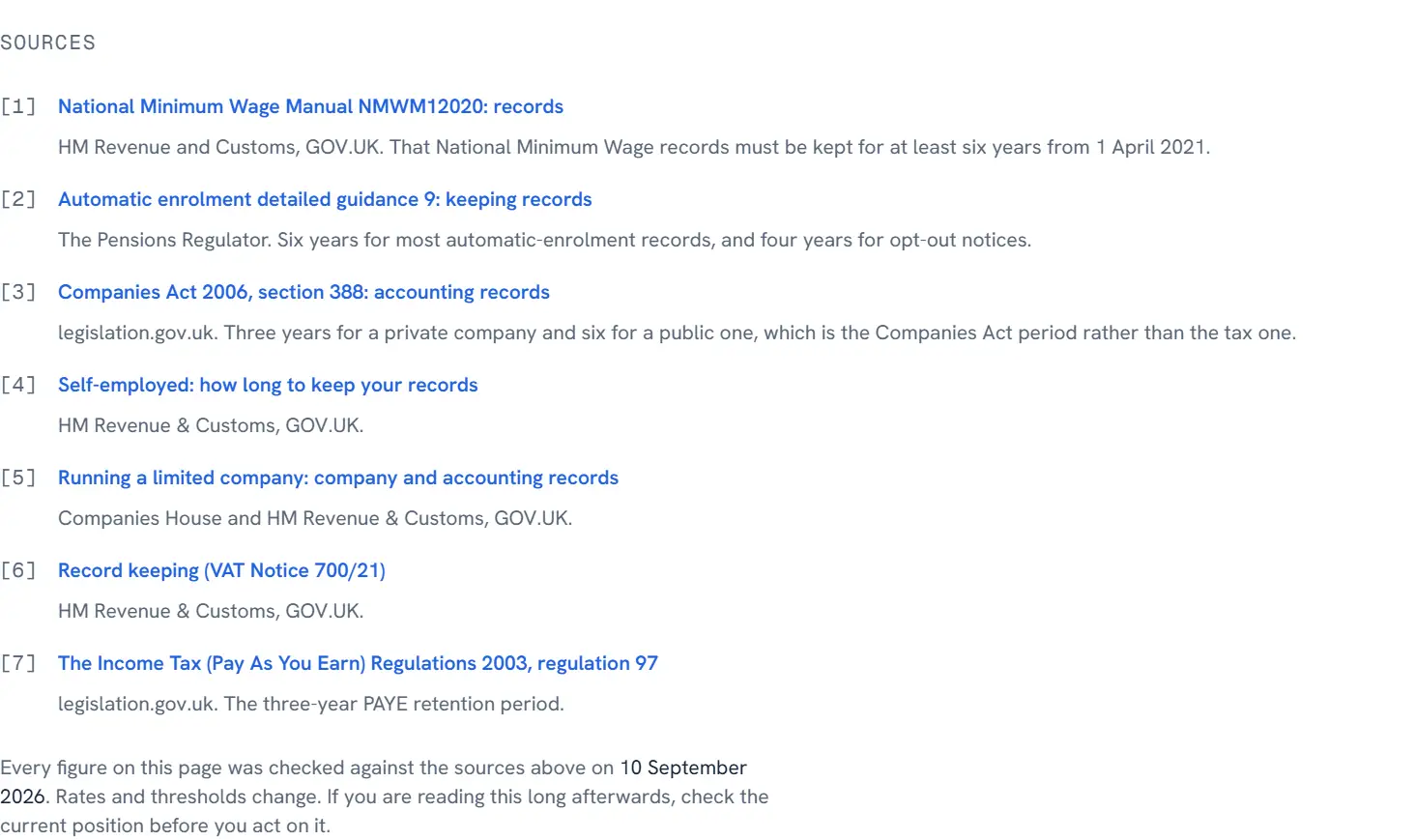
The article on how long to keep business records shows the standard well: five years after the 31 January deadline for a sole trader, six years from the end of the accounting period for a limited company, three years for PAYE, each tied to the GOV.UK or legislation page it comes from, plus a section on where the common seven-year belief comes from. The Companies House identity verification article is the other one I would point an accountant to. It makes clear there is no single deadline that applies to everyone, which is exactly the kind of nuance a hurried article leaves out.
Tickdoc's Design, Rebuilt From Evidence, Not Adjectives
I will be honest about our first home page, because it is the most useful thing in this section. We built it to a design brief written in adjectives, and it came out exactly as dull as that sounds: two neutrals, no imagery, and one change of tone in sixteen thousand pixels of page. I looked at it and threw it away before it ever reached the staging site. A brief made of adjectives can be satisfied by almost anything, which is why it so often produces nothing in particular.
The second brief was written from rendered evidence instead: colour swatches drawn on screen, type specimens set at real sizes, real photographs. It produced a deep blue and a warm amber. Sibo had told us early on that she likes blue, and her first reaction to the new direction was to the ticks and the touch of orange. Every colour pairing was then measured by script rather than judged by eye, as we did on the Cordley Solutions build: 48 of 48 gated pairs pass WCAG, and a second check confirms the colours the browser actually paints match the ones in the palette. One rule fell straight out of the measurements. White text on that amber measures 2.1:1, so amber always carries dark text, a trap we describe in our post on brand colours that fail accessibility.
The type is Outfit for headings, Hanken Grotesk for text and Geist Mono for figures, served as four self-hosted font files totalling 51 KB. There is no request to the Google Fonts CDN, so no visitor's IP address goes to a third party just to draw a heading.
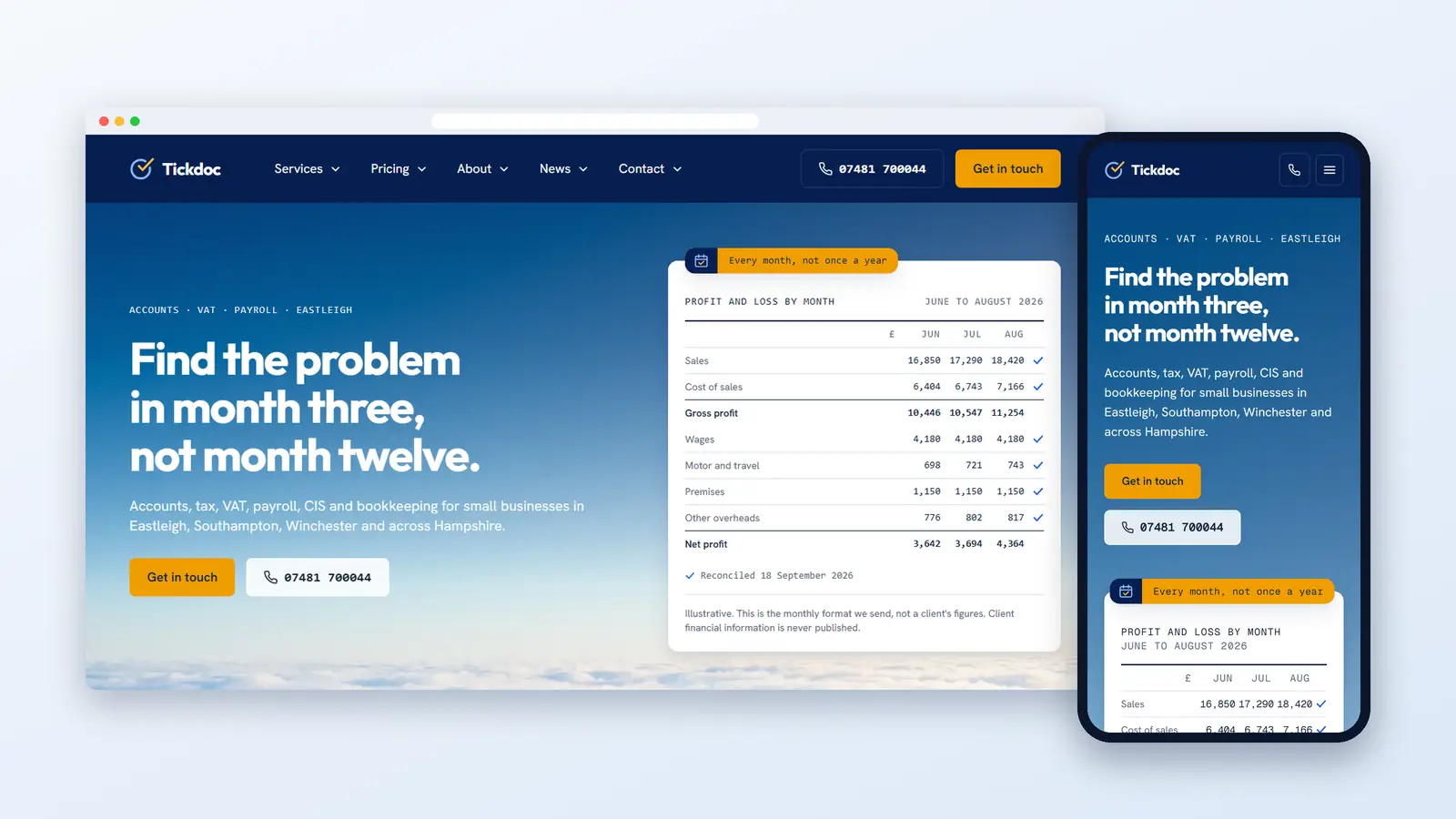
The hero carries the thing a Tickdoc client actually receives: a monthly profit and loss. Its figures count up, and the tick beside each line lands only once that figure has settled, because on this site a tick means a line has been checked. The figures are illustrative and the card says so in plain words. One of the automated gates confirms that every column of that illustrative profit and loss adds up, because an accountant website whose sample accounts did not reconcile would be a poor advert.
The logo, redrawn from her own mark
We did not replace Tickdoc's logo. The ring and the tick were hers, and they stayed. What changed was everything that stopped them working at small sizes. We redrew the mark as a vector in two tones, sized the gap in the ring so the tick passes through it, and moved the practice name out of the ring into its own wordmark, where it can be read at any size. Sibo asked, reasonably, whether it had to change at all. Once she had seen it working she was happy to go with it, and she received a pack of 54 files covering every format she is likely to need.

Eleven Accountancy Service Pages, Each a Full Article
Here is another of our own mistakes. Our first draft of the eleven service pages averaged 52 words each, little more than a caption on a price; the VAT returns page had 21. They were rewritten the same day from Sibo's own answers to our questionnaire about how each service works, what clients ask and where things tend to go wrong.
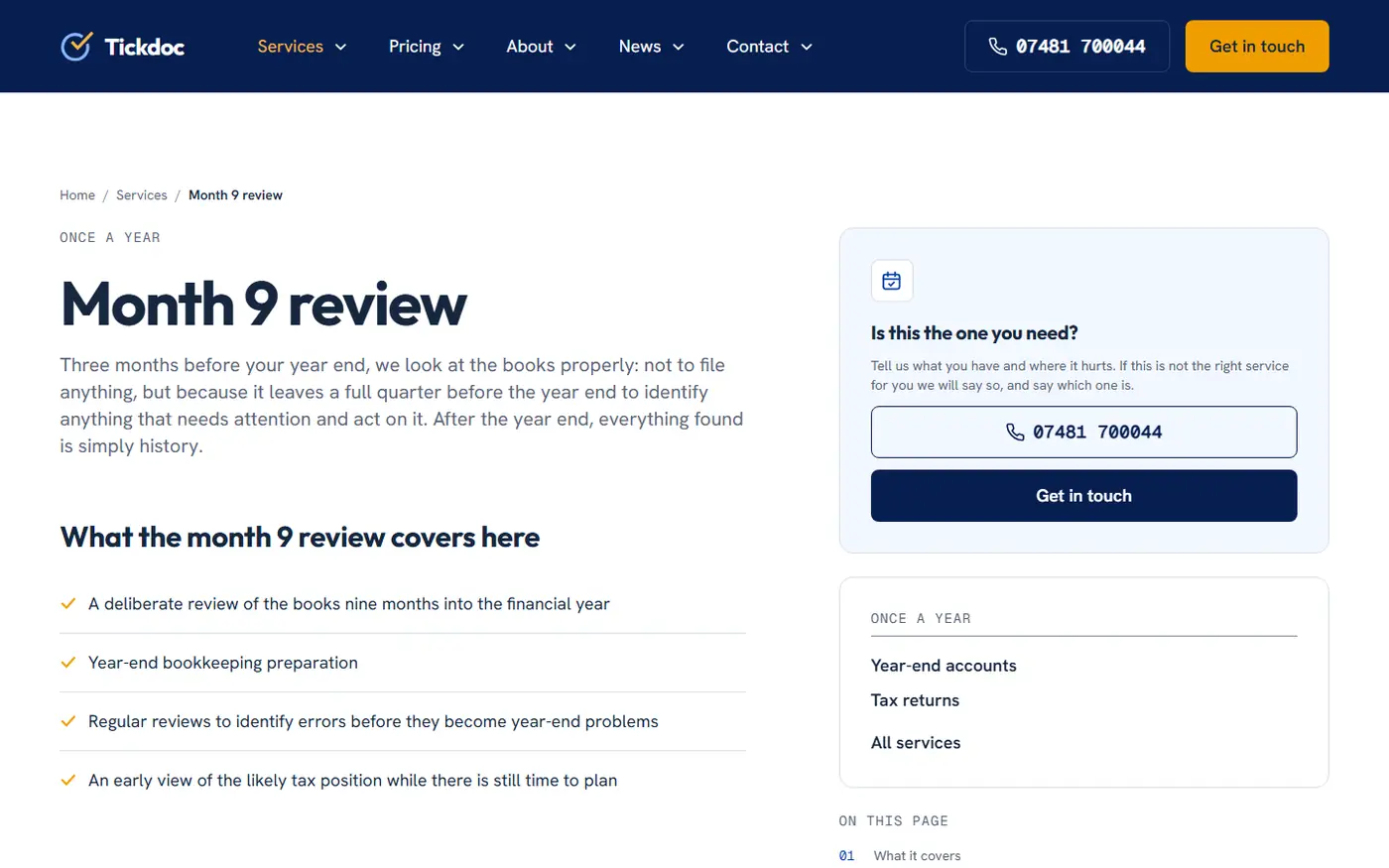
Service pages are the part of an accountant website that does the selling, so each service page now reads as an article: roughly 1,200 to 1,600 words of body and FAQ, six to eight sections, six questions with matching FAQPage schema, a contents rail, and hasPart schema so Google can offer "jump to" links. The bookkeeping page and the monthly management accounts page carry the practice's core work. The month 9 review page is my favourite, because it explains the whole proposition through a single service: a deliberate look at the books three months before the year end, while there is still a quarter left to do something about what turns up.
Since then the service pages have had two more passes from Sibo, the second of them read as a client would read them rather than as an accountant would. That is the read that catches a page which is accurate and still unclear.
PageSpeed 100 on Mobile: How the Last Three Points Were Won
The PageSpeed Insights mobile report we are quoting was run on 9 October 2026 at 1:04 pm. It scores 100 for Performance, Accessibility, Best Practices and SEO, with First Contentful Paint at 1.1 s, Largest Contentful Paint at 1.8 s, Total Blocking Time at 30 ms, Cumulative Layout Shift at 0.003 and Speed Index at 1.1 s. Scores vary between runs, so open the saved report or re-run it yourself. Largest Contentful Paint and layout shift both sit well inside Google's Core Web Vitals thresholds. One honest caveat: these are lab figures. The real-user section of the report says "No Data", because the site is too new for Chrome's field data, and field data is the measurement that will matter.

The day before, the site sat at 97, and a Lighthouse trace showed why. The home page painted completely, then the mobile menu flashed open across the screen and slid away, and the hero rebuilt itself with its figures reset to zero. Scripts that ran after the first paint were undoing what the visitor could already see. Speed Index, which measures how quickly content is visually displayed, was 4.4 seconds against a first paint of 1.4.
The fix was a tiny first-frame marker, inline in the page head, so that deferred scripts can tell whether the page has already been drawn. Here it is, formatted for reading:
<!-- In the <head>, before any other script: note when the first frame is drawn -->
<script>
(function () {
  var t;
  requestAnimationFrame(function () { t = performance.now(); });
  window.tickPaintedFor = function () {
    return t === undefined ? 0 : performance.now() - t;
  };
})();
</script>
// In a deferred script: never re-animate what the visitor can already see.
if (window.tickPaintedFor && window.tickPaintedFor() > 100) {
return; // the page has been on screen for over 100 ms, so leave it alone
}Our first version of the marker used the browser's first-contentful-paint entry, and on the live site it never fired. Paint entries are delivered late: under Lighthouse's throttling the entry was still empty when the script ran, although the screen had been drawn 450 milliseconds earlier. Only the frames in the trace showed that. With the marker in place, Speed Index came back into line. The same day, Accessibility went from 96 to 100: two small reCAPTCHA links in the footer relied on colour alone to look like links, and setting them in a heavier weight fixed it.
Layout shift had its own story a month earlier. On a phone, the home page measured 0.2875 against Google's "good" threshold of 0.1 or less, because the web fonts arrived late and the text reflowed when they did. Web performance specialist Barry Pollard describes the mechanism exactly:
"Web fonts are another common cause of CLS due to the browser initially calculating the space needed based on the fallback font, and then recalculating it when the web font is downloaded."
Barry Pollard, How To Fix Cumulative Layout Shift (CLS) Issues, Smashing Magazine, June 2021
That is what we were seeing, and the fix took two parts. Preloading the four fonts on its own left the shift at 0.2875. Preloading them together with font-display: optional, which tells the browser to keep the fallback font rather than swap in a late one, took it to zero. The trade is real and worth knowing: on a slow first visit someone may see the fallback font. We took it, because a page that does not move under a reader's thumb matters more than a typeface. It is the same budget-first approach we apply on our own site, described in our PageSpeed 100 case study, and in our speed optimisation work on WordPress.
Eight Google Reviews, Every Reply, and No Review Schema
Tickdoc's eight Google reviews, and every one of Sibo's replies, appear on the home page and on a dedicated reviews page. They are synced weekly from the Business Profile API, and nothing is edited or left out, including the one review that is not five stars.
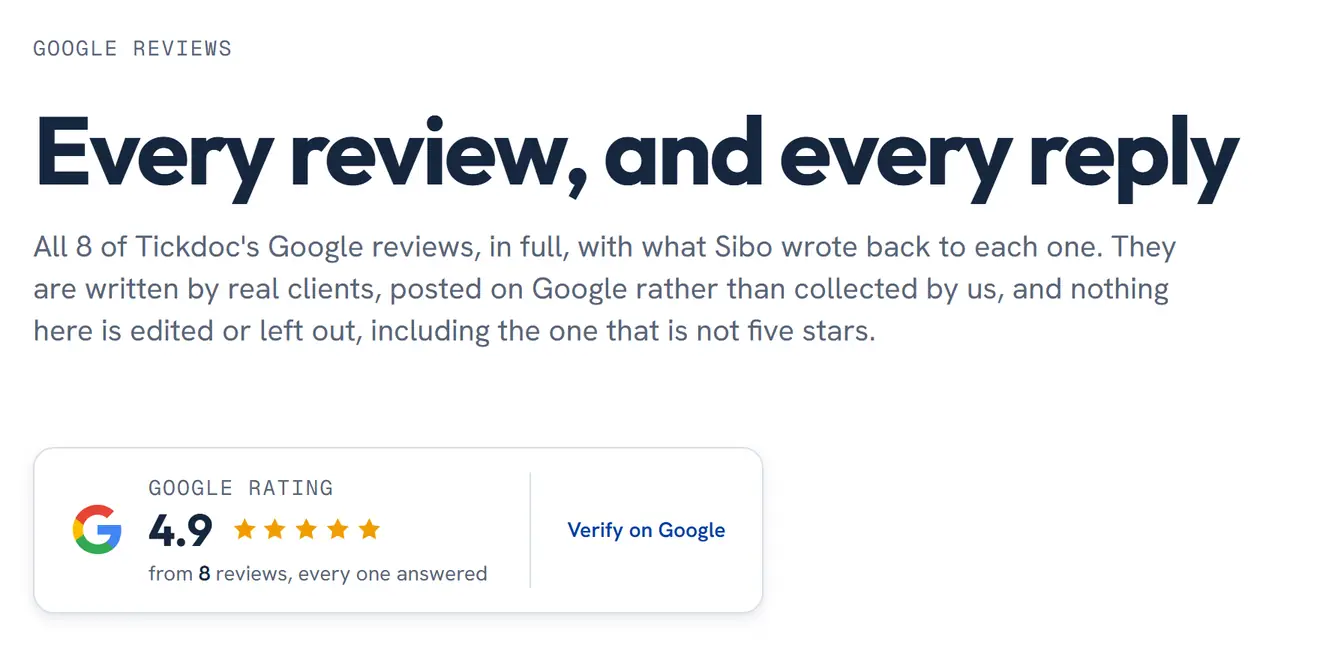
What the page does not have is Review or AggregateRating schema, and that is deliberate. It would have taken minutes to add, and plenty of sites do it. Google's review snippet guidelines say this about reviews a business shows about itself:
"If the entity that's being reviewed controls the reviews about itself, their pages that use LocalBusiness or any other type of Organization structured data are ineligible for star review feature."
Google Search Central, Review snippet structured data guidelines
Notice what that sentence does and does not say. Google is not threatening a penalty; its 2019 announcement of the rule says plainly that there is no manual action for it. It says the page is ineligible, and the same guidelines name embedded widgets showing Google reviews as part of the pattern. So the markup would earn nothing and would claim something the page is not entitled to, on a site whose whole proposition is that every claim can be checked. The reviews do their work as visible, verifiable text with a link to the Google profile, which is where they belong. We made the same call for Splat Decorating, a painter and decorator with 94 reviews across Google and TrustATrader, all shown word for word and none marked up.
AI Search for Accountants: Discovery Files and Sitemaps
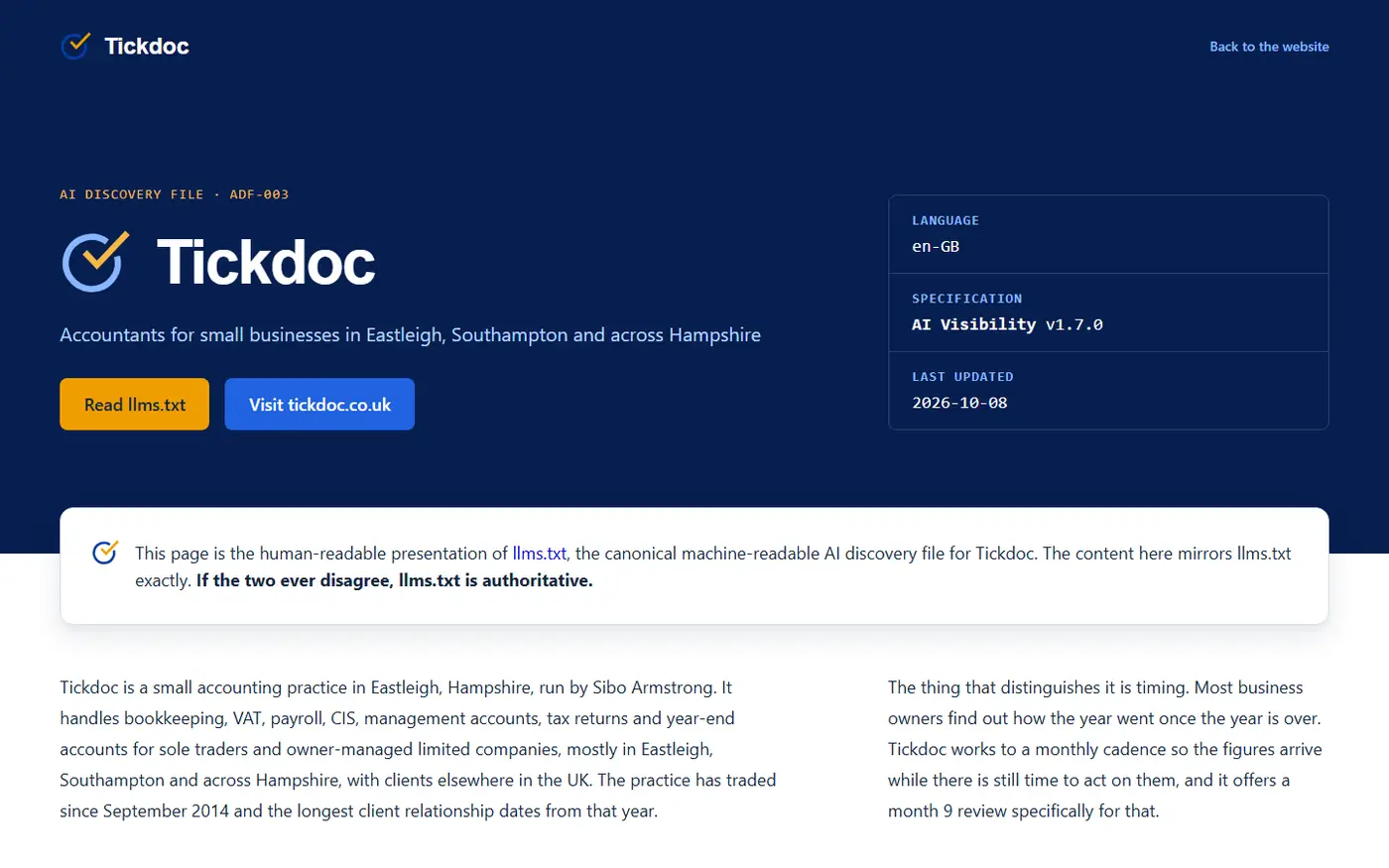
More people now ask an AI assistant to find an accountant before they type anything into Google, and AI search for accountants rewards the same thing Google does: clear facts from a first-party source. The site ships all ten AI Discovery Files to the AI Discovery Files specification, generated from the same data as the pages so the two cannot drift apart. The human-readable version, llms.html, is a designed, indexable page; the other nine carry a noindex header so they do not spend crawl budget.
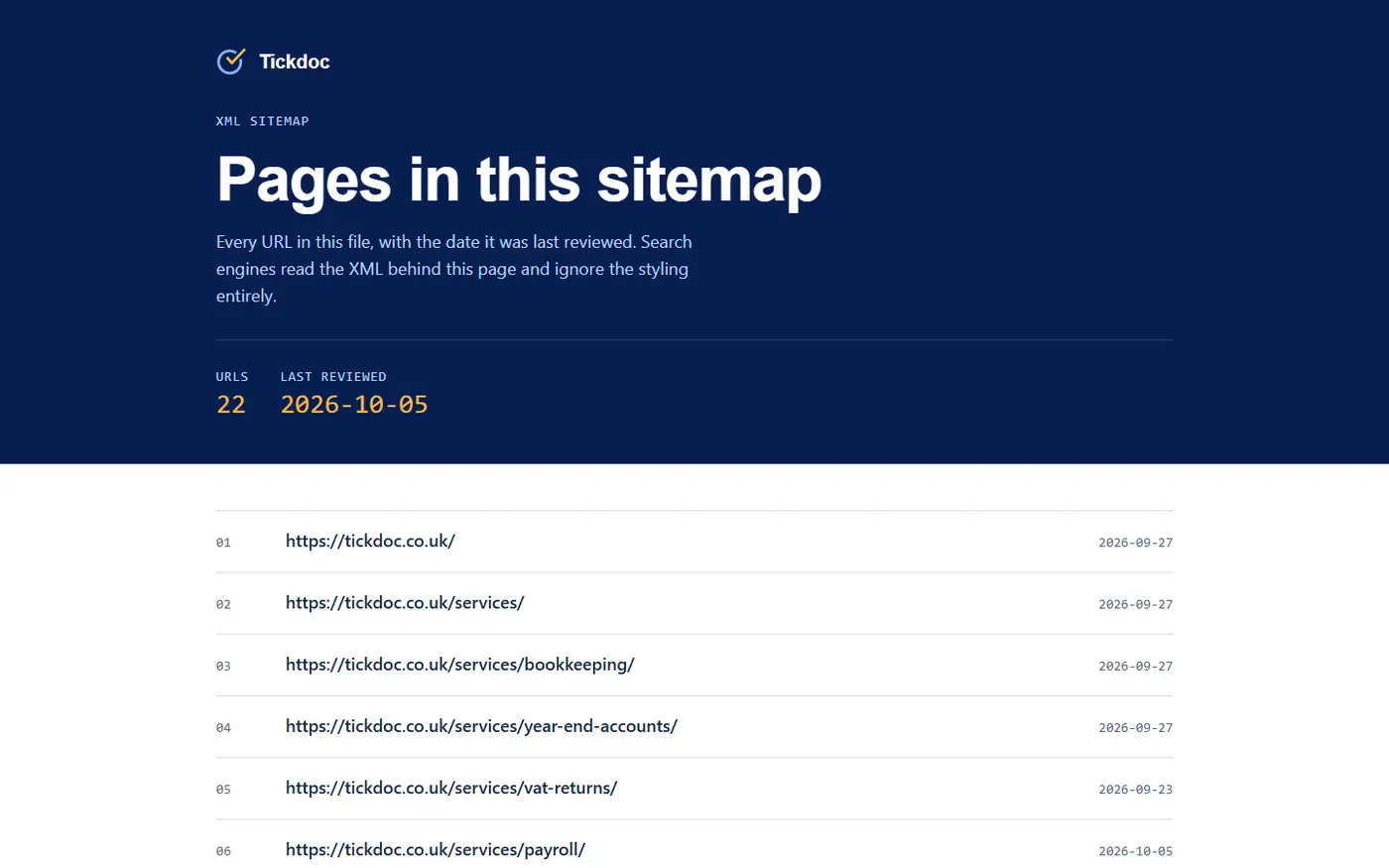
The XML sitemaps are designed as well. Open the sitemap in a browser and you get a readable list of every URL with the date it was last reviewed, while search engines read the XML underneath and ignore the styling. Every old URL redirects to its new home in a single 301 hop, and a page that no longer exists returns 410 Gone rather than redirecting somewhere irrelevant.
The Google Business Profile got the same care. We rewrote the description to name the place and the services. Seventeen service entries became fifteen, each with a description. Service areas went from eight to twenty, Google's maximum. Categories went from three to five, deliberately not ten, leaving out any that would overclaim what the practice does. And all twelve articles were posted to the profile on launch day. We set out the wider pattern in what a local business website needs in 2026, and the reasoning behind first-party facts in our piece on the non-commodity content Google rewards.
19 Quality Gates, and the Faults We Found Anyway
The site runs nineteen automated quality gates in one command, and each one exists because something went wrong first. They measure contrast as the browser actually paints it, hover states included; check the type against a baseline grid and a maximum line length; catch shadows clipped by their containers; test every internal link and every promised anchor; render both contact emails and check their contrast; and confirm that the illustrative profit and loss adds up.
The honest half of this section is what the gates did not catch, or caught late:
- The animation layer hid 24 of the site's 32 headings from screen readers. Fixed, and now gated.
- The contact form sent nothing during the build while PHP's
mail()function reported success. We moved it to authenticated SMTP before launch. - On launch day, every page was downloading all four fonts twice, because the preload links and the stylesheet asked for them by slightly different URLs. Fixed the same day.
- The day after launch, on a real phone, a row in the mobile menu turned navy on navy once it had been tapped shut. Every gate had driven the browser with a mouse, so we wrote one that drives it by touch.
The contact form itself now has a honeypot, a signed timestamp, a rate limit and reCAPTCHA v3, which loads only when someone starts filling the form in. A live test from an automated browser scored 0.1 and was refused. It sends two HTML emails: one to Sibo, and one to the enquirer with a copy of their own message. There is no cookie banner, because nothing on the site sets a non-essential cookie; the newsletter talks to MailerLite from the server rather than loading an embed script that would. The one limit we state plainly: once reCAPTCHA loads, Google may set its own cookie, and the site's privacy copy says so.
Working With Sibo Armstrong on the Tickdoc Website
I want to say this plainly, because it is true and it is easy to leave out of a case study: we enjoyed this build enormously, and most of the reason was Sibo.
She was exact without ever being difficult. Her review notes arrived organised by priority, with the replacement wording already written, which made acting on them a pleasure rather than a chore. She held a firm line on anything technical and gave us room on design, which is exactly the right division of labour between an expert and the people building her website. When we got something wrong she said so clearly and kindly, and when we asked her a question she answered it properly, however small it was.
The care shows in the result. The site is better because she read every line of it, and so is the way we work: the fact-check-before-drafting method that came out of her review is how every article on her site is now written, and it is the standard I would hold any financial website to. Creating a site for someone who cares that much about getting it right has been one of the most satisfying projects we have taken on this year.
What This Accountant Website Case Study Can't Claim Yet
Most accountant website design case studies end on launch day with a screenshot. This one has to stop short of results, and says so. Launch was agreed for 2 October 2026. Sibo moved the nameservers a day early, and the site simply went live on the 1st with nothing redeployed, because the staging and live sites share one document root and the environment is decided by the hostname. At the time of writing, the new site has eight days of history and Search Console has data for six of them.
Show the daily figures
| Date | Impressions | Site |
|---|---|---|
| 17 September 2026 | 7 | Old |
| 18 September 2026 | 9 | Old |
| 19 September 2026 | 9 | Old |
| 20 September 2026 | 7 | Old |
| 21 September 2026 | 6 | Old |
| 22 September 2026 | 6 | Old |
| 23 September 2026 | 2 | Old |
| 24 September 2026 | 11 | Old |
| 25 September 2026 | 9 | Old |
| 26 September 2026 | 2 | Old |
| 27 September 2026 | 10 | Old |
| 28 September 2026 | 15 | Old |
| 29 September 2026 | 2 | Old |
| 30 September 2026 | 4 | Old |
| 1 October 2026 | 18 | New |
| 2 October 2026 | 49 | New |
| 3 October 2026 | 63 | New |
| 4 October 2026 | 70 | New |
| 5 October 2026 | 126 | New |
| 6 October 2026 | 93 | New |
In the fortnight before launch, the old site drew between 2 and 15 impressions a day. From 2 to 6 October, the new site drew between 49 and 126 a day, across 105 distinct queries in its first six days of data. The statutory sick pay article is averaging position 6.2.
Now the caveat, which matters more than the chart. Average position got worse, not better, because Google is testing dozens of new pages deep in its results: the new management accounts page has been shown 70 times at an average position of about 65. That is an early indexing signal, not a ranking result. Google is still swapping the old URLs for the new ones, the twelve Business Profile posts sent some traffic of their own, and the first four to six weeks after any launch are noisy. Clicks are still in single figures.
The fair comparison comes after the first full quarter: October to December 2026 against the same quarter of 2025, and the queries the site was built to win, read row by row, including "accountant eastleigh" from its baseline of 21.9 and "bookkeeping eastleigh" from 89.2. When those figures exist they will be on this page, whichever way they point. It is the same standard we set on the Brewood Removals rebuild and Lincolnshire Chauffeur Services, and the reason the Lockerfella study still lists the head term it has not won.
Frequently Asked Questions
What should an accountant's website include?
A page for each service that explains how the work is done, not just a price; figures and rules tied to GOV.UK or HMRC with the date they were checked; clear pricing where the practice publishes it; real reviews shown in full with the replies; and a contact route that works on a phone. Tickdoc's site adds a month 9 review page, a news section where every article lists its sources, and AI Discovery Files so assistants describe the practice accurately.
What is the best website builder for accountants?
There is no single best builder. WordPress suits a practice that wants to publish and edit pages itself, and it is what we build most often. A hand-built site suits a practice whose pages change a few times a month and which wants the fastest possible result with nothing to update. Tickdoc chose the hand-built route. What matters more than the platform is the content standard: sourced figures, honest pricing and pages written from how the practice really works.
How long should an accountancy service page be?
Long enough to answer what a client actually asks. Our first draft of Tickdoc's service pages averaged 52 words, which answered nothing. Each page was rewritten from the director's own answers about how the service works, and they now run to roughly 1,200 to 1,600 words of article and FAQ, with six to eight sections, six questions each, a contents rail and matching schema. Length was the result of answering the questions, not the target.
Why doesn't the Tickdoc website use review schema for its Google reviews?
Because Google's review snippet guidelines say a business that controls the reviews about itself is ineligible for review stars on pages using LocalBusiness or Organization markup, including reviews shown through an embedded widget. Marking them up would claim something the page is not entitled to. All eight reviews and every reply are shown in full as visible text instead, synced weekly from the Business Profile API.
Is the Tickdoc website built on WordPress?
No. It replaced an old WordPress site built with the Divi theme, and the new one is hand-built PHP with vanilla CSS and JavaScript, no framework and no build step, hosted on 365i behind its CDN. The director asked for a static, hand-built site. The content standards, schema, performance budget and AI Discovery Files all apply equally to the WordPress sites we build.
How did the Tickdoc site reach PageSpeed 100 on mobile?
Through two fixes most sites never look for. Layout shift on a phone was 0.2875 because web fonts arrived late; preloading the four self-hosted fonts and setting font-display to optional took it to zero. Then the score sat at 97 because scripts running after the first paint rebuilt content the visitor could already see. A small inline first-frame marker lets those scripts skip anything already on screen. The mobile run on 9 October 2026 scored 100 in all four categories.
Does an accountancy website need AI Discovery Files?
It helps. More people now ask an AI assistant to find or describe a local accountant, and the assistant answers from whatever machine-readable facts it can find. Tickdoc ships all ten AI Discovery Files to the published specification, generated from the same data as the pages so they cannot drift, including a designed, indexable llms.html. They cost little to build and give an assistant a first-party source for the services, locations and prices.
Has the new website improved Tickdoc's rankings yet?
It is too early to say. The site went live on 1 October 2026. Daily impressions rose from between 2 and 15 a day before launch to between 49 and 126 a day in its first week of data, but average position got worse as Google tested new pages deep in the results. That is an indexing signal, not a ranking result. We will compare the first full quarter with the same quarter of 2025 and publish the figures here, whichever way they point.
Sibo Armstrong's Google Review of Press Forge
A week after launch, Sibo left a five-star review on our Google Business Profile. Here it is in full, exactly as it appears on Google, with our reply underneath.
Mark at Press Forge built our new website and I am really pleased with the result. He took the time to understand the business properly rather than simply producing a standard accountancy website, and the finished site feels professional, modern and much more reflective of our practice.
I am very particular about detail, and Mark was patient throughout and always willing to discuss the reasoning behind the design and wording. Press Forge also put a lot of thought into the technical side, SEO, mobile performance and how the site would work for both clients and search engines.
The end result is a website I am proud to send clients to. I would definitely recommend Press Forge to any small business looking for a bespoke website and a developer who takes the time to really understand the business.
We loved working with you, Sibo, to create your new website. It's a stunning site and your attention to detail is what really made the difference. Thank you for the lovely review.
The line I would underline is the one about being particular about detail. Every row in the review ledger above came from it, and the site is better for each one of them.
Is Your Practice's Website as Careful as You Are?
If your work depends on being accurate, your website should be too. We will look at your current site honestly, tell you what we would change and why, and build it to the standard you have just read about, on WordPress or by hand. Tell us about your practice and we will quote within 24 hours.
Get a Free QuotePublished: 9 October 2026 · Last reviewed: 9 October 2026 · Written by: Mark McNeece, Founder & Lead Developer, Press Forge
Editorially reviewed by: Mark McNeece on 9 October 2026 · Our editorial standards
Sources & Evidence
- tickdoc.co.uk - the live site (check the sources, the reviews and the discovery files yourself)
- PageSpeed Insights mobile report for tickdoc.co.uk, 9 October 2026 at 1:04 pm
- Our latest update to the quality rater guidelines: E-A-T gets an extra E for Experience - Elizabeth Tucker, Google Search Central Blog
- Creating helpful, reliable, people-first content - Google Search Central
- Review snippet structured data guidelines (self-serving reviews) - Google Search Central
- Making review rich results more helpful - Google Search Central Blog, September 2019
- How To Fix Cumulative Layout Shift (CLS) Issues - Barry Pollard, Smashing Magazine
- Cumulative Layout Shift (CLS) and the 0.1 threshold - web.dev
- Speed Index - Lighthouse, Chrome for Developers
- font-display - MDN Web Docs
- Travel, mileage and fuel rates and allowances - GOV.UK
- Self-employed: how long to keep your records - GOV.UK
- Running a limited company: company and accounting records - GOV.UK
- Tickdoc Ltd, company 09237448 - Companies House
- AI Discovery Files specification - AI Visibility Definition
- 365i Linux web hosting - where the site runs
